
In this Article
- Key Takeaways: The Belgian Waffle Divide
- Understanding Belgium's Waffle Heritage
- The Brussels Waffle: Light and Crisp
- The Liège Waffle: Rich and Caramelized
- The Iron Makes the Waffle: Traditional Equipment
- How to Eat Them Like a Local
- Bringing the Tradition to Your Kitchen
Key Takeaways: The Belgian Waffle Divide
I treat the Belgian waffle divide as a production-method question first, not a topping question. A waffle buried under syrup and candy cannot be identified reliably by toppings alone; the batter or dough structure is the better evidence.
- There is no single Belgian waffle in Belgium. The two main styles are Brussels and Liège.
- Brussels waffles are light, airy, rectangular, and made from a thin batter that runs into a deep iron.
- Liège waffles are dense, sweet, and unevenly rounded because they start as dough balls, not ladled batter.
- Brussels waffles usually get sweetness after cooking; Liège waffles carry sweetness inside through pearl sugar.
| Feature | Brussels Waffle | Liège Waffle |
|---|---|---|
| Mixture | Thin, pourable batter | Thick, brioche-like dough |
| Leavening | Usually yeast; sometimes assisted by whipped egg whites | Yeast |
| Shape | Large rectangle with deep square pockets | Irregular oval or rounded rectangle |
| Sweetness | Lightly sweetened or nearly unsweetened base | Sweet dough with pearl sugar folded in |
| Best setting | Seated café service | Street snack or bakery counter |
Critical Insight: A rectangular shape does not automatically prove Brussels style because some electric irons make rectangular waffles from nontraditional baking-powder batter.
Understanding Belgium's Waffle Heritage
Belgian waffle history is practical before it is picturesque. Cooks used the ingredients, irons, and selling spaces they had, and the styles hardened into habit over time.
The Brussels waffle belongs naturally to café service. It comes from a loose fermented batter, goes onto a large rectangular iron, and lands on a plate while the surface is still crisp. That crisp edge is short-lived; once steam softens the shell, the charm fades quickly. This is why a proper Brussels waffle feels like something you sit down for rather than something you carry around in a paper sleeve.
Liège tells another story. Its dough is enriched with butter and eggs, handled as portions, and cooked into a chewy snack with caramelized sugar in the crust. Bakeries and street vendors preserve the difference every morning by the way they work: Liège dough is shaped and held as pieces, while Brussels waffles are usually cooked to order from batter.
The regional split is not a tidy museum label. Brussels has its own urban food identity, while Liège sits firmly in Wallonia; both traditions also overlap with broader Belgian habits of yeast dough, iron cooking, and market eating. The official culinary heritage of Flanders presents waffles as part of a living food culture rather than a single fixed recipe.
The Brussels Waffle: Light and Crisp
What to Look For
A Brussels waffle should look almost architectural: one large rectangle, deep square pockets, straight edges, and a pale golden finish. The structure matters because those pockets hold air as much as toppings.
The batter is closer to crêpe batter than bread dough. It should pour, spread quickly, and fill the corners of the iron without being shoved around with a spatula. When the yeast has done its work, the surface shows small bubbles and smells lightly fermented.
Batter, Heat, and Timing
For a yeast Brussels batter, according to local expertise, a common resting window is 45–90 minutes at warm room temperature. The iron surface usually sits around 190–205°C, with cooking taking in the ballpark of 3–5 minutes depending on grid depth and batter thickness.
That heat creates the signature contrast: crisp outside, airy inside. The base is only lightly sweetened or nearly unsweetened, so icing sugar is not just decoration. It supplies much of the sweetness you notice in a classic café plate.
Recommendation: Eat a Brussels waffle within roughly 3–7 minutes of leaving the iron. Waiting too long turns a crisp waffle into a soft one, even if the recipe is excellent.
The Liège Waffle: Rich and Caramelized
The Dough Is the Evidence
Liège waffles begin as dough balls, often in the 80–120 g range before cooking. Under pressure, they spread into uneven ovals or rounded rectangles, which is exactly what they should do.
The dough is brioche-like: kneadable, elastic, and enriched with butter and eggs. It is not pourable, and it should not behave like pancake batter. If you can ladle it easily, you are no longer in Liège territory.
Pearl Sugar Changes Everything
The crucial ingredient is coarse Belgian-style pearl sugar, typically in pieces around 4–8 mm. The sugar is folded into the dough after the first rise so the grains stay intact. Once the dough hits the hot iron, some pieces melt, some caramelize, and some leave sticky pockets in the crumb.
A practical home schedule is 60–90 minutes for the first rise, then 10–20 minutes after folding in the pearl sugar before cooking. Liège waffles often cook a little cooler than Brussels waffles, around 175–190°C, because sugar burns faster than dough sets.
Risk Factor: A Liège waffle that is cooked too hot can taste bitter even if the dough recipe is correct, because leaked pearl sugar burns faster than the enriched dough cooks.
The finished waffle should not be evenly golden. Look for caramelized sugar patches at the edges and in the grid marks. Those amber spots are the point.
The Iron Makes the Waffle: Traditional Equipment
The iron is part of the recipe. Brussels batter needs rapid lift and evaporation in a deep rectangular grid; Liège dough needs steady heat and a surface that can tolerate molten sugar.
Brussels Irons
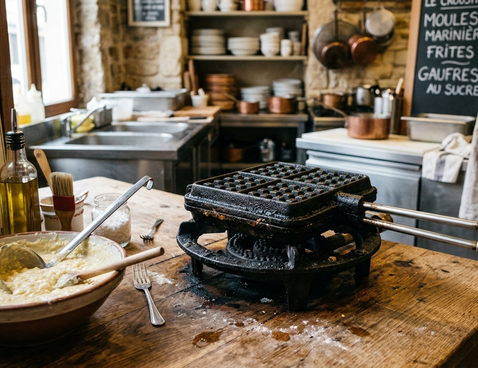
A Brussels iron generally needs deeper pockets than a standard shallow breakfast-waffle plate, commonly around 2–3 cm deep. That depth gives the batter room to expand without turning bready. Light plates often drop temperature after the first waffle, which leaves pale centers and a limp crust.
Liège Irons
A Liège iron can be more compact, but it must survive caramel. Non-removable plates are harder to clean once melted sugar creeps into hinges or seams. If sugar leaks, wipe it away while the iron is still warm but not fully hot; once cold, caramel turns brittle and stubborn.
I keep this step close to the cooking itself, not as a chore for later. A warm cloth and a little patience save the next batch from burnt sugar smoke.
How to Eat Them Like a Local and What to Avoid
Local-style eating follows the design of the waffle. Brussels waffles need a light finish because the base is restrained. Liège waffles need almost nothing because the sugar is already baked into the dough.
Brussels Café Style
A classic Brussels café order is one waffle on a plate, finished with icing sugar, sometimes strawberries or a small portion of whipped cream. You eat it with cutlery while it is hot enough to crackle at the fork.
This is not the place for a tower of sauce, candy, cream, and syrup. Those toppings cover the very traits that separate the waffle from any other sweet snack.
Liège Street Style
A classic Liège waffle is handed over in paper and eaten plain, warm, and slightly sticky. It should be satisfying as it is. The caramel crust, buttery crumb, and uneven chew do the work.
Critical Insight: In central tourist corridors, a pre-cooked waffle reheated under chocolate sauce, candy, cream, and syrup will usually taste more like toppings than waffle; coastal resorts and fairground stands can have their own local habits.
If the display emphasizes tall piles of toppings more than the iron or fresh cooking, expect softer texture and less distinction between Brussels and Liège styles.
Bringing the Tradition to Your Kitchen
At home, the biggest gains come from respecting three things: sugar format, yeast fermentation, and rest. Shortcuts can still produce a pleasant waffle, but they will not produce the same texture.
For Liège Waffles
- Use coarse pearl sugar rather than crushed sugar cubes. Crushed sugar dissolves too quickly and misses the caramel pockets.
- Let the enriched dough complete its first rise before adding the sugar.
- Fold in the pearl sugar gently, then rest the dough another 10–20 minutes before cooking.
- Cook until the edges show amber caramel and the dough feels set.
Expect the full dough process to take roughly 1 hour 30 minutes to 2 hours 30 minutes before cooking, depending on room temperature and yeast activity. Very dark mahogany edges usually mean leaked sugar has burned.
For Brussels Waffles
- Make a pourable batter, not a dough.
- Let it rest 45–90 minutes before cooking.
- If you refrigerate it overnight, bring it toward room temperature for 30–45 minutes before using.
- Serve quickly with icing sugar, strawberries, or a modest amount of cream.
Baking powder can inflate batter fast, but it does not bring the same fermented aroma or delicate structure. Yeast is not a decorative old-world detail here; it is one of the reasons the waffle tastes Belgian rather than merely waffle-shaped.
Recommendation: Decide which waffle you are making before you heat the iron. Brussels asks for batter, speed, and crispness. Liège asks for dough, caramel, and patience.

Comments
Start the discussion.
Join the Discussion