
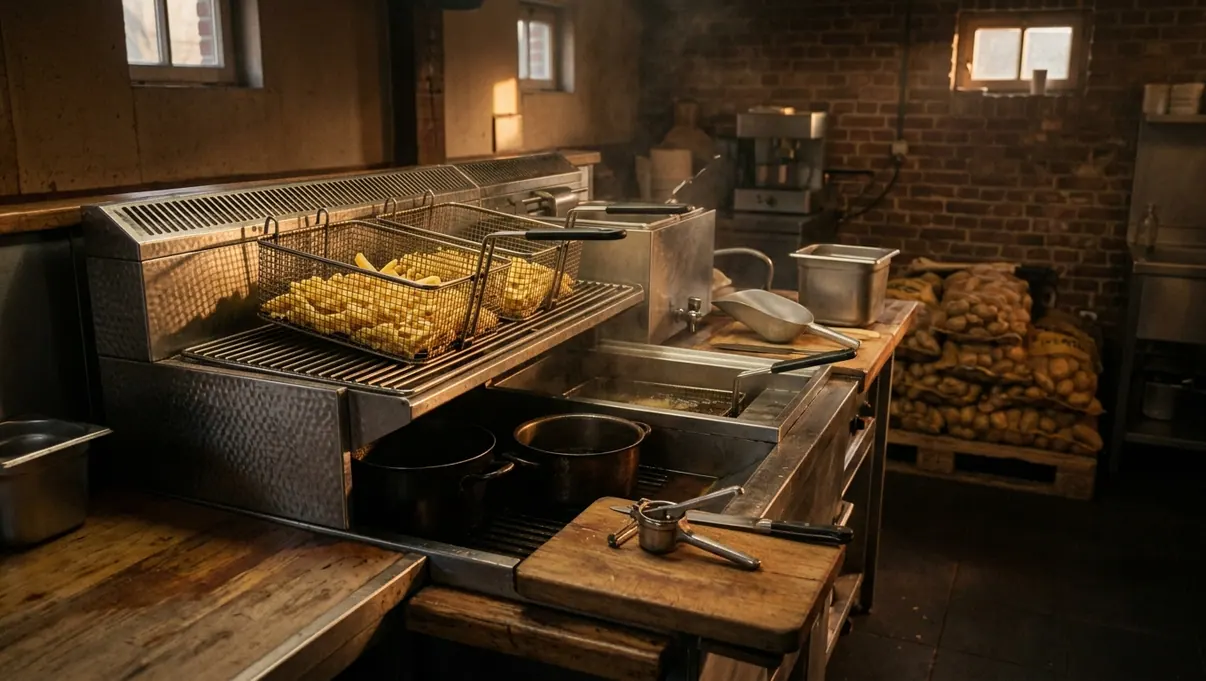
A Belgian frite is not just a fried potato. It is a small engineering problem dressed as street food: dry matter, hot fat, steam pressure, and timing all arguing in the same pot.
I care about the argument because the best frites make no apology for themselves. They arrive crisp enough to tap against the cone, then give way to a soft, potato-rich middle. That contrast does not come from luck. It comes from choosing the right potato, using the right frying medium, and refusing to rush the second fry.
In this Article
- Key Takeaways: The Anatomy of a Perfect Frite
- Sourcing the Foundation: Why the Bintje Potato Matters
- Blanc de Bœuf: The Secret Ingredient of Belgian Fritkots
- Mastering the Double-Fry Process
- Limitations and Common Frying Mistakes
- The Fritkot Experience: Serving and Sauces
Key Takeaways: The Anatomy of a Perfect Frite
According to local expertise, the order matters. Potato solids first. Frying medium second. Heat schedule third. Moisture management all the way through.
When a batch goes wrong, people often blame the final fry. Sometimes that is fair. More often, the problem began earlier, with a wet potato, a waxy variety, or a crowded pot that never had a chance to recover heat.
- Use floury potatoes. In Belgium, Bintje remains the reference point because it gives the interior enough mealiness to steam soft without turning gluey.
- Cut generously. For home batches, aim for 10-12 mm sticks. Thin fries crisp fast, but they lose the plush center expected from Belgian frites.
- Fry in beef tallow when tradition is the goal. Blanc de Bœuf gives the crust a savory aroma that vegetable oil rarely matches.
- Separate cooking from crisping. The first fry belongs in the 130-140°C range. The second fry belongs in the 170-180°C range.
- Rest the fries. A 30-90 minute room-temperature rest lets surface moisture redistribute and dry before the final crisping stage.
Key point: Belgian frites are built during the pale first fry, not saved during the golden second one.
Sourcing the Foundation: Why the Bintje Potato Matters
Start with the potato, not the fryer. A perfect temperature curve cannot rescue a potato with the wrong internal structure.
The starch-to-water balance
The center of a Belgian frite needs to steam and soften while the outside dries enough to blister. That points toward mature, floury potatoes with high dry matter. The phrase sounds technical, but the eating result is simple: soft inside, crisp outside, no squeak.
Waxy new potatoes can look beautifully cut and still produce dense frites. They hold their shape, yes, but they do not relax into that fluffy center during le pochage, the first fry. I avoid them for Belgian-style cuts.
Why Bintje remains the Belgian benchmark
Bintje has the right culinary temperament. It is not flashy. It simply behaves well through two heat cycles, especially when cut thick enough to protect the center.
Choose mature potatoes that feel heavy but not wet. The skins should be firm, with no green patches and no sprouts pushing 2-3 mm. Storage matters too. Keep frying potatoes in a cool, dark place in the ballpark of 7-10°C. Storage below roughly 6°C can increase sugar development, which makes fries brown too quickly before the center has the texture you want.
Good substitutes outside Belgium
If Bintje is unavailable, do not turn the search into a pilgrimage. Russet, Maris Piper, Agria, or King Edward can stand in, especially for 10-12 mm Belgian-style cuts.
North American Russets often brown faster than Bintje, particularly after cold storage. Use the lower end of the second-fry range and judge by crust color rather than extending time automatically.
- Rinse cut sticks through 2-3 changes of cold water until the water looks less cloudy.
- Soak or rinse for 10-20 minutes if the potatoes are very starchy on the surface.
- Dry thoroughly with towels before frying; the towels should stop picking up visible moisture.
Blanc de Bœuf: The Secret Ingredient of Belgian Fritkots
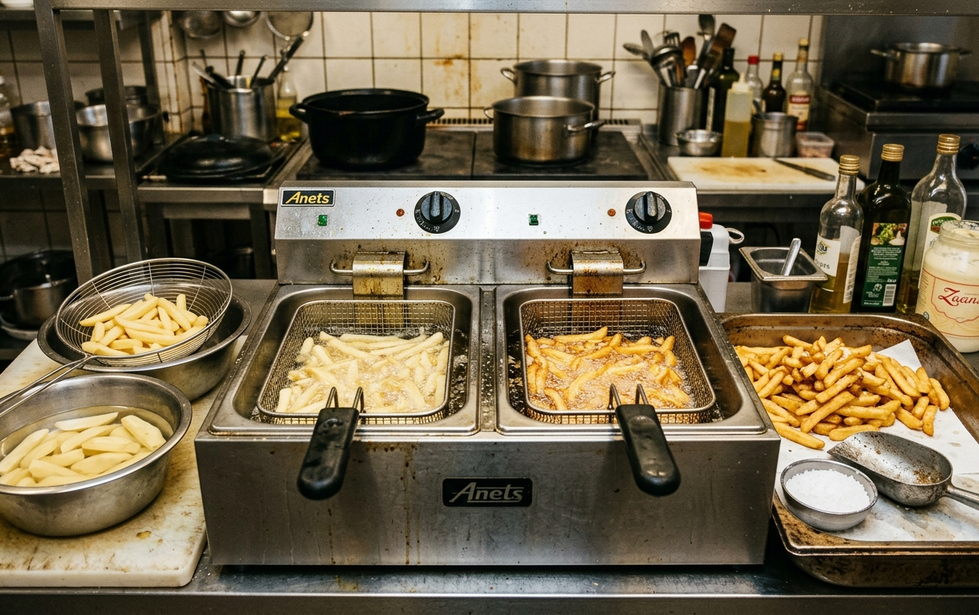
Blanc de Bœuf is beef tallow, and in the Belgian fritkot tradition it is not a nostalgic ornament. It changes the aroma of the potato.
The historical story of Belgian fries is tangled, proudly argued, and part of the national food identity; the official history of Belgian fries gives useful cultural context. In the fryer, though, the practical reason is easier to taste. Beef tallow carries a rounded, savory note and helps the crust finish dry rather than slick.
Flavor and browning
The Maillard reaction needs heat, amino compounds, reducing sugars, and a surface dry enough to brown instead of steam. Potatoes bring the starch and sugars; the frying medium shapes the flavor carried to the nose. Tallow gives the crust a deeper savory character, especially on thick frites where the outside must stand up to a soft center.
Vegetable oil can make good fries. It just does not make the same frite.
Heat behavior in a home pot
Melt beef tallow slowly over low heat before raising it to frying temperature. Solid chunks pressed against a hot pot base can scorch before the full mass liquefies.
For a heavy pot hovering around 24-26 cm, do not fill beyond halfway with melted fat. Wet potatoes bubble hard, and the pot needs vertical space. Once the session is over, filter cooled but still liquid tallow through a fine metal sieve to remove potato crumbs. Those crumbs darken the fat during later batches and bring bitter notes with them.
Practical measure: Use enough fat for the fries to move freely: roughly 2.5-3.5 liters for a 350-500 g raw-potato batch in a home fryer or heavy pot.
Mastering the Double-Fry Process
The double fry works because it assigns different jobs to different temperatures. The first fry cooks the potato. The rest manages moisture. The second fry builds the crust.
Preparation: cut, rinse, dry
- Peel the potatoes, or scrub them well if you prefer a rustic edge.
- Cut them into sticks about 10-12 mm thick.
- Keep the pieces similar in size so the final fry colors evenly.
- Rinse in cold water until the water is less cloudy.
- Dry until towels no longer pick up visible surface moisture.
This last step is not optional. Adding a full bowl of rinsed but damp potatoes to hot tallow can cause violent bubbling and a fast temperature drop. The thermometer may have read correctly at the start, yet the fries still turn greasy because the fat cooled at the worst possible moment.
First Fry: le pochage
Set the fat to 130-140°C. Fry for 5-8 minutes, depending on the potato and cut. Stop when the fries bend slightly and look matte, not golden.
That paleness is the point. If the fries brown during the first fry, the surface is moving too fast while the interior is still catching up.
The resting phase
Spread the blanched fries on a rack or paper-lined tray and let them cool to room temperature for 30-90 minutes. They should feel cool before the second fry.
During this pause, steam leaves the surface and the potato structure firms enough to handle the final heat. Skip it and you ask the second fry to dry, crisp, and finish cooking all at once. It usually refuses.
Second Fry: le dorage
Raise the fat to 170-180°C. Fry for 2-4 minutes, shaking once or twice, until the crust is golden with small blisters at the edges.
Do not let the pot climb to pushing 185°C during recovery. More heat is not more Belgian. It is just a faster route to dark edges and a hollow-tasting crust.
Limitations and Common Frying Mistakes
Most home frying problems come from temperature recovery and trapped moisture. The fix is usually less dramatic than people expect: smaller batches, drier potatoes, longer rests.
Overcrowding the fryer
In a home pot, keep each batch to roughly one loose layer in the basket or spider. For many kitchens, that means 300-500 g raw potato at a time.
If the fat drops below 125°C during the first fry, wait for it to return to 135-140°C before adding the next batch. If it drops below 165°C during the second fry, pause until it returns to at least 170°C. This is where patience tastes better than efficiency.
Skipping or shortening the rest
A soggy result after correct temperatures usually points to wet raw potatoes, an abbreviated rest, or stacking hot fries in a deep bowl.
Hot frites keep releasing steam. Pile them deep and the lower layer softens under its own vapor. Use a rack, a shallow tray, or a paper cone that lets some moisture escape.
Home fryers versus commercial fryers
Commercial fryers recover heat faster because they hold more oil and use stronger heating elements. A domestic pot often needs 3-6 minutes between batches to regain temperature.
That limitation does not make home frites second-rate. It means the cook must work in smaller loads and respect the thermometer. One catch sits outside technique: beef tallow is not suitable for vegetarian diners and can conflict with kitchens that avoid animal fat for religious or dietary reasons.
Common failure: Crowding turns hot fat into a lukewarm bath, and potatoes absorb that mistake quickly.
The Fritkot Experience: Serving and Sauces
Serving is part of the method. A frite loses its best texture within minutes if steam has nowhere to go.
The paper cone and the salt
Salt immediately after draining, while the surface still carries a trace of fat. Then move the frites into a paper cone, shallow tray, or rack-lined bowl rather than a sealed container.
Serve within 2-5 minutes of the second fry. That is the window where the crust still cracks lightly and the center remains tender.
Sauces beyond mayonnaise
Mayonnaise is the familiar choice, but a Belgian fritkot counter offers a wider vocabulary: Andalouse, Samourai, tartare, and pickles-based sauces all belong in the conversation.
Keep the portion modest. Roughly 30-45 ml per person is enough for dipping without drowning the fries. Sauce should frame the potato, not bury it.
With moules, or alone on the street
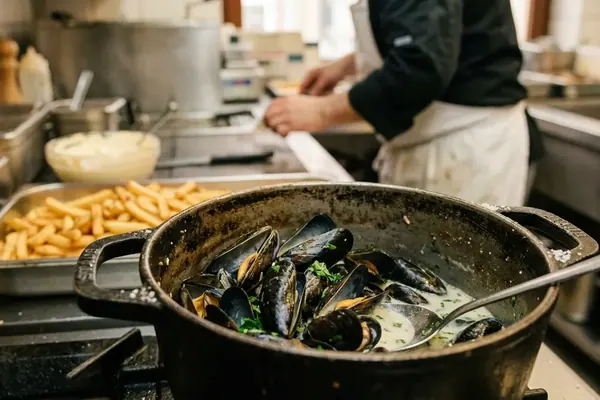
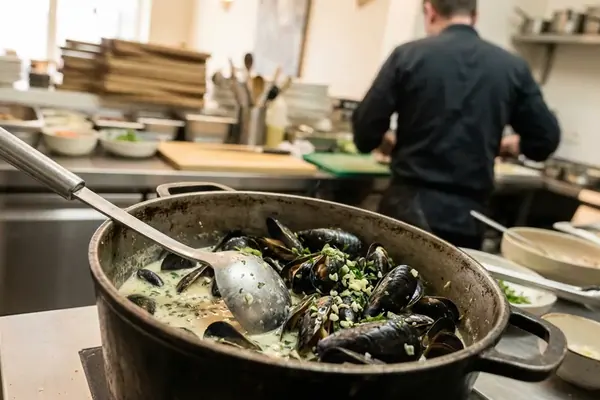
For moules frites, timing matters. Clean the mussels and prepare the aromatics first, then run the final fry while the mussels steam during their last few minutes. The broth arrives fragrant, the frites arrive crisp, and neither waits for the other.
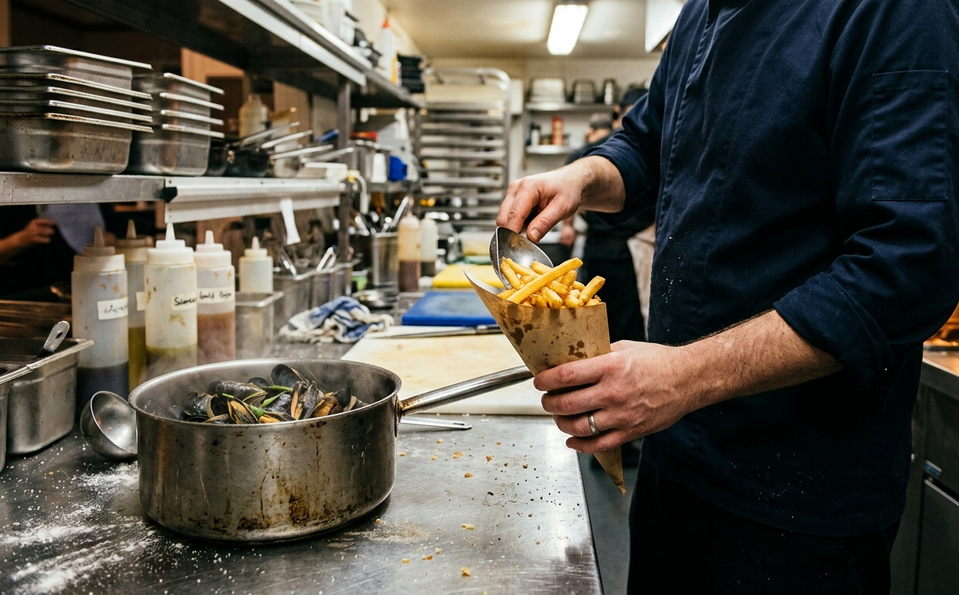
Still, a paper cone eaten standing up has its own authority. No mussels, no plate, no ceremony. Just hot frites, salt on the fingers, and the quiet proof that the double fry earned its reputation.


Comments
Start the discussion.
Join the Discussion