
In this Article
- The Essence of Belgium's National Dish
- From Poor Man's Meat to Culinary Staple
- The Disputed Origins of the Belgian Fry
- The Historic Pairing: When Moules Met Frites
- Evolution of the Classic Recipe
- Historical Ambiguities and Culinary Myths
- Experiencing the Tradition Today
The Essence of Belgium's National Dish
A dish built from two older habits
I do not think of moules frites as a recipe with a neat birth certificate. I think of it as a meeting point: coastal mussel eating on one side, urban fry culture on the other, both practical before they became beloved.
That is why the dish still feels so Belgian. It is generous but not fussy. A pot arrives hot, the lid lifts, steam carries wine, parsley, shellfish liquor, and butter, and the fries sit apart so they keep their snap. The pleasure is immediate, but the structure is old and sensible.
A defensible timeline runs like this: mussels were common coastal food before the 1800s; potatoes spread through Belgian regions during the 1700s; fried potatoes became urban street food in the 1800s; moules frites became a recognizable brasserie order in the late 1800s to early 1900s.
In short: The national dish emerged by convergence, not by one inventor. Mussels brought the estuary and coast; fries brought the street stall and the city.
From Poor Man's Meat to Culinary Staple
The shellfish geography mattered first
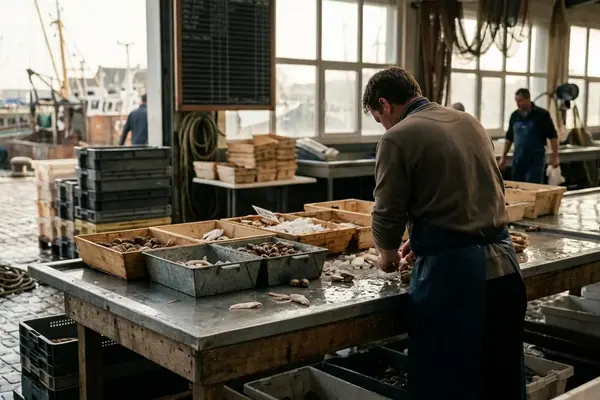
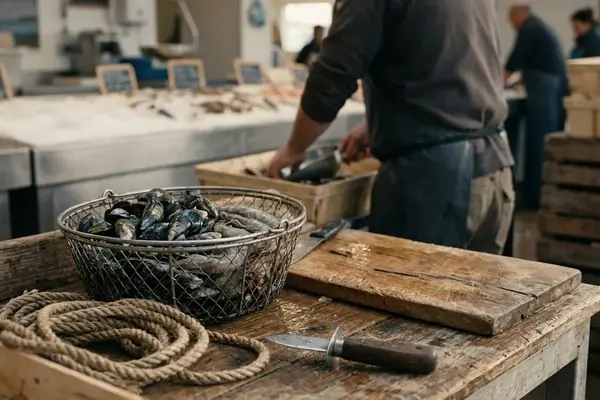
The mussel story starts in cold, tidal places rather than polished dining rooms. The Flemish coast, the Scheldt estuary, and the wider southern North Sea trade area supplied the shellfish that Belgian cooks learned to handle with confidence.
Mussels earned the old nickname “poor man's meat” honestly. They were accessible protein, especially in winter, when rough seas and limited preservation made fresh finfish less dependable. Live mussels could be held briefly in baskets, barrels, or sacks kept damp and cool, which suited short-market distribution long before modern cold chains.
How mussels reached Brussels
Brussels was not a fishing village, but it was never cut off from shellfish. The Brussels-Willebroek canal, opened in the 16th century, gave the city a more direct connection with the Scheldt trading system. Later 19th-century transport improvements made regular inland shellfish sales easier.
This is the practical part I always come back to when reading old food customs. A dish becomes “traditional” only when supply, cooking fuel, cookware, and appetite all line up. Mussels lined up well. They cooked quickly, fed many, and tasted like more than their price suggested.
The older Belgian habit of eating mussels in the cooler “R-months,” roughly September through April, grew from that same practical world. Modern aquaculture and logistics have stretched availability, but the seasonal memory still shapes how many brasseries talk about their best pots.
The Disputed Origins of the Belgian Fry
Potatoes before the legend
Before fries could become Belgian, potatoes had to become ordinary. Potato cultivation spread through the Low Countries and present-day Belgium mainly during the 1700s, after earlier introduction to Europe in the 1500s and 1600s.
The famous Meuse Valley story usually sits around Dinant and Namur. According to local guides, households near the river fried small fish when they could catch them; when freezing weather blocked that habit, they cut potatoes into fish-like strips and fried those instead. It is folklore, but good folklore often preserves the shape of local necessity.
The method that made the fry worth defending
The Belgian fry is not just a potato baton in hot fat. According to local expertise, traditional versions are generally thicker than many fast-food fries, often around 10 to 13 mm across. That thickness matters because it gives the cook room to build a soft interior before crisping the outside.
- Cut the potatoes thick enough to protect a creamy center.
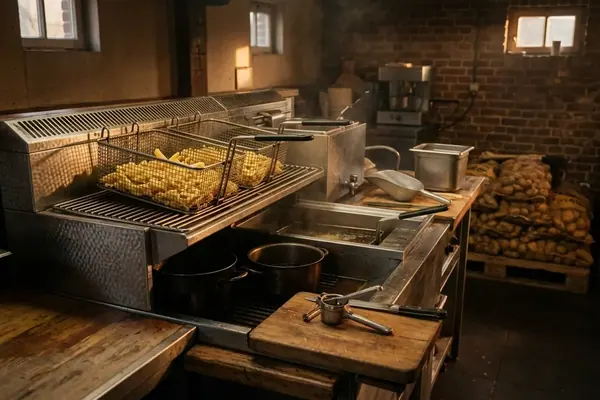
- Cook them first at a lower heat, around 130 to 150°C, for roughly 5 to 7 minutes.
- Let them cool for about 10 to 30 minutes, which is not optional if texture matters.
- Finish them hotter, around 175 to 180°C, for roughly 2 to 3 minutes.
Old fry shops often used blanc de bœuf, rendered beef tallow. It tolerates high frying temperatures and gives a savory crust that neutral oil does not fully copy. That flavor is one reason Belgians can argue about fries with the seriousness other people reserve for borders.
Home tip: If you want a historically minded fry at home, respect the pause between the two fries. Rushing that rest gives you hot potatoes, not Belgian fries.
The Historic Pairing: When Moules Met Frites
Industrial hunger shaped the plate
The strongest convergence window for moules frites is the mid- to late 19th century, especially the decades after Belgian independence in 1830. Brussels, Antwerp, Ghent, Liège, and industrial towns expanded quickly, and people needed hot food that did not behave like a banquet.
Mussels and fries solved three problems at once. Mussels steamed in a lidded pot in minutes. Fries provided satiety. Both could be served without elaborate tableware.
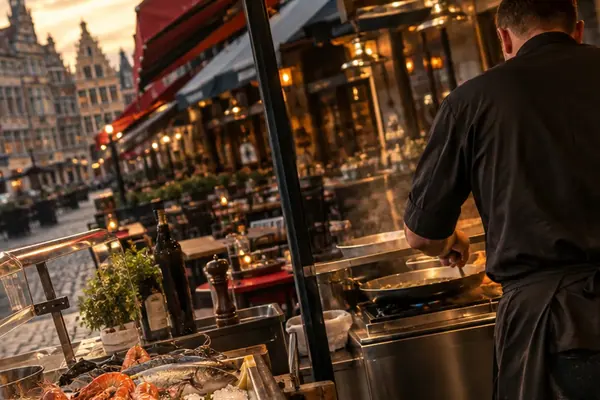
Fry shacks and mobile fry sellers became visible features of Belgian urban eating during the second half of the 1800s. The fritkot gave the city a cheap hot starch, while markets and brasseries supplied foods that could sit beside it. Mussels were an obvious companion because they were quick, aromatic, and communal without being expensive in their original setting.
The brasserie made the combination legible
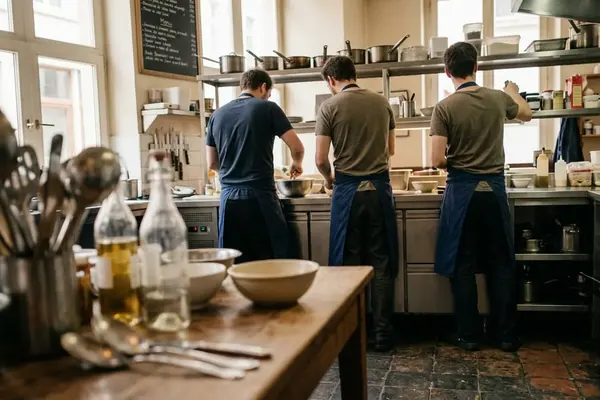
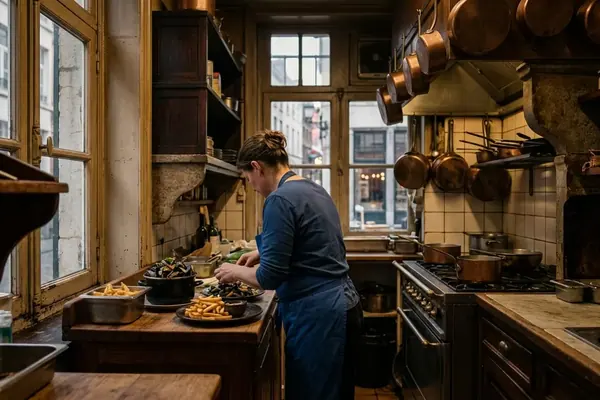
Early brasserie logic favored moules frites because the workflow was clean. Mussels could be steamed to order in one vessel, while fries could be produced continuously in batches and served separately. The result felt fast, but not careless.
This is also where the dish gained its social range. A worker could eat it for fuel. A traveler could read it as local color. A family could order several pots and pass shells, fries, mayonnaise, and stories around the table.
Evolution of the Classic Recipe
Marinière as the baseline
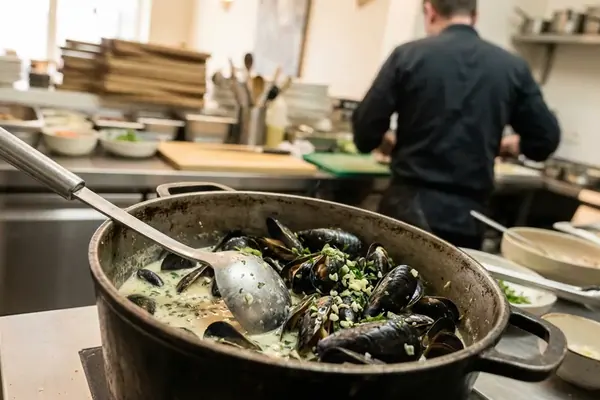
Moules Marinière became the reference point because it does not smother the mussel. The usual base is short and fragrant: shallots or onion, celery, parsley, butter, white wine, and pepper. Once the lid closes, the mussels steam partly in their own released liquor.
A contemporary Belgian restaurant portion commonly uses around 1 kg of live mussels per diner, sometimes a little more. At home, about 1 kg per person is practical, provided the pot has enough headspace for shaking. Overcrowding keeps mussels from opening evenly and pushes broken shells to the bottom.
Regional flavor without losing the dish
The cooking liquid is where local identity shows itself most clearly. Belgian-style variations include wheat beer or pale ale, garlic cream, mustard-accented sauces, and herb-heavy pots with parsley, celery leaf, or chervil.
The best versions still taste of mussels first. Cream can be lovely, but when it turns the pot into a heavy sauce with shellfish hidden inside, the dish loses its old brasserie rhythm.
The pot is part of the recipe
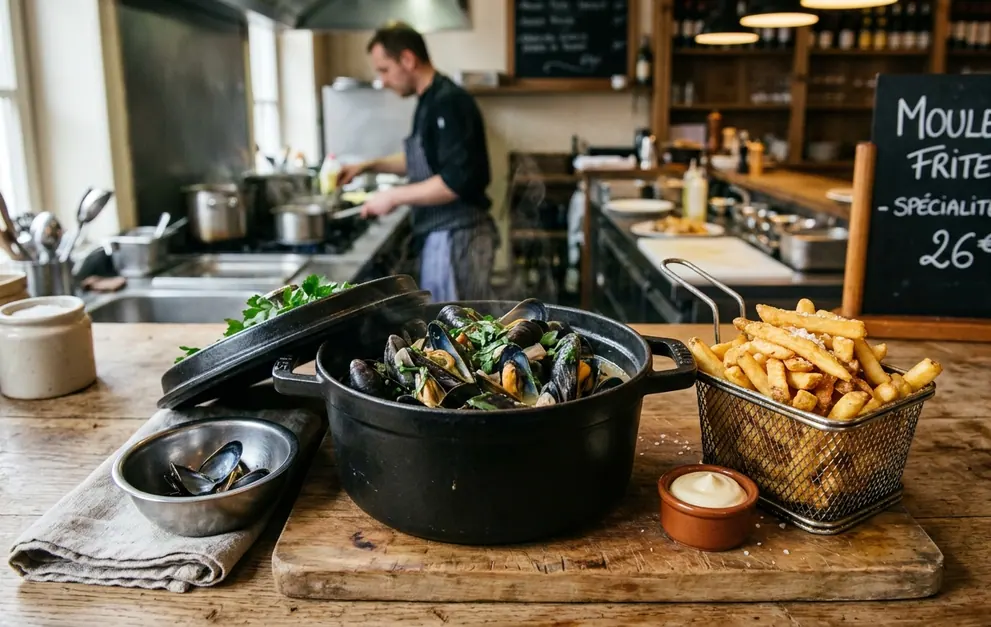
The black enamel mussel pot became iconic for good reasons. Enamel resists salty cooking liquid, the dark surface hides staining, and the deep lidded shape traps steam. At the table, the inverted lid often becomes the shell bowl, which is one of those small design decisions that feels obvious only after someone else thought of it.
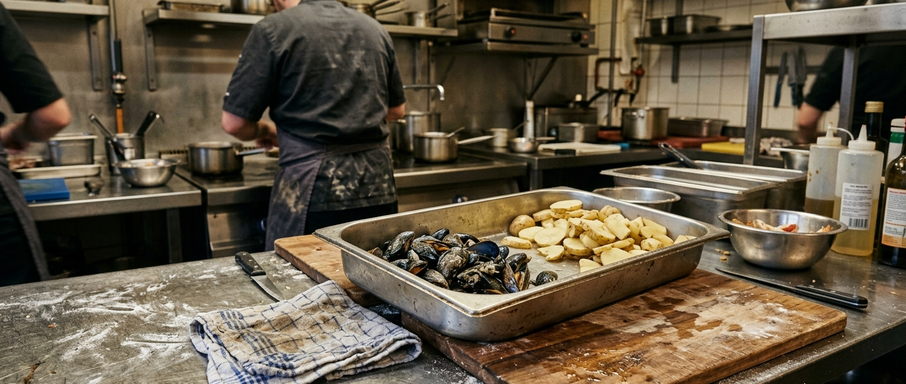
Fresh live mussels should be scrubbed and debearded shortly before cooking. Any open mussel that does not close after a firm tap is usually discarded before the pot goes on the heat.
Watch for: A restaurant can serve mussels and fries together without preserving the Belgian dish structure if the mussels are pre-cooked, reheated in a heavy cream sauce, and plated under fries that turn limp from steam.
Historical Ambiguities and Culinary Myths
What the records can and cannot prove
No widely accepted surviving menu or recipe pinpoints the first plated serving of mussels with fries. The better-supported account is a 19th-century convergence of transport, street frying, and mussel-market access; the mid-19th-century pairing window is best treated as a practical historical estimate, not proof of the first shared table.
That uncertainty should not disappoint anyone. Ordinary commerce leaves uneven records. Street vendors, household cooks, and modest brasseries rarely documented themselves with the care of hotels or elite restaurants.
The friendly fry argument
The Belgian-French fry dispute remains difficult to settle. The word “French” in English-language fry terminology does not prove French national origin, and Belgian oral tradition preserves its own Meuse Valley explanation.
Food historians work here with indirect evidence: market access, canal and rail transport, potato adoption, street-vendor practice, household habits, and later brasserie menus. Oral traditions matter especially in fry culture because many early sellers worked from stalls and street settings, where paperwork was thin.
Claiming a precise invention year for moules frites overstates the evidence. Calling it a Belgian convergence dish is less tidy, but much more honest.
Experiencing the Tradition Today
What to look for in Brussels
In Brussels brasserie service, mussels commonly arrive in an individual lidded pot, with fries on the side and mayonnaise or a house sauce served separately. That separation is not decorative. Fries placed over steam soften, which defeats the whole point of the double fry.
A good pot should smell marine and aromatic, not fishy. Most shells should be open after steaming, and the liquor at the bottom should be cloudy-briny from mussel juices rather than watery.
- Look for mussels cooked to order, not held and reheated.
- Expect fries in a cone, bowl, or basket beside the mussel pot.
- Choose sauces that support the shellfish rather than bury it.
- Notice whether the pot arrives lidded and hot enough to carry steam to the table.
Honoring the method at home
Home kitchens often scale down to shared pots because domestic burners and cookware may not handle multiple servings in the ballpark of 1 kg at once. That is not a betrayal of the tradition. It is the same practical thinking that created the dish in the first place.
Buy live rope-grown or bottom-cultured North Sea-region mussels during the cooler season when you can, cook them the same day, and avoid long soaking in fresh water. For the fries, use floury Belgian-style varieties such as Bintje or similar high-starch potatoes, keep the cooling pause between fries, and salt immediately after the second fry.
The final plate should feel lively: briny steam, crisp potatoes, a little mayonnaise, and enough shells on the table to slow the conversation down. That is the history of moules frites at its best, not trapped in a museum, but eaten while still hot.

Comments
Start the discussion.
Join the Discussion