
The Cost of Choosing the Wrong Brasserie
Choosing poorly in central Brussels can mean paying brasserie prices for oysters opened well before service, tired mussels and a dining room assembled from generic vintage props. The greater loss is the evening itself: a full seafood-brasserie meal commonly takes 90–120 minutes once an aperitif, shellfish course, main dish and coffee are included.
Treat the room and seafood counter as a single purchasing decision. Decorative ironwork cannot rescue a waterlogged plateau de fruits de mer. Excellent shellfish served in an anonymous room may satisfy dinner, yet it leaves out the architectural dimension that makes historic Brussels dining distinctive.
I allow 5–10 minutes before sitting down to inspect the façade, entrance vestibule, main room and visible shellfish counter. This short circuit reveals more than the menu board on the pavement. The reward is a unified encounter with Belgian cuisine: pristine shellfish, practiced service and a period interior shaped by a tradition extending back more than a century.
Check Before Seating
Confirm what is historically protected, follow the decorative language from the entrance into the room, and look for an active écailler. Leave before ordering if pre-opened oysters are sitting in shallow meltwater.
A Three-Pass Brasserie Check
Selection works best in three passes. Documentary evidence establishes the building’s history. Physical details show whether that history survives in the dining room. The seafood counter then indicates whether the kitchen treats shellfish with equal seriousness.
The Three-Pass Test
- Verify the setting: Check the Brussels regional heritage inventory and identify whether protection applies to the façade, interior or particular decorative components.
- Read the whole room: Look for connected period elements such as botanical ironwork, fitted woodwork, stained or leaded glass, patterned tile and integrated lighting.
- Inspect the cold display: A proper platter rests on abundant crushed ice, remains cold through the opening minutes and avoids stagnant water around the shells.
- Watch the counter: An écailler opening oysters, replacing ice and clearing shell debris gives useful evidence of current turnover.
- Smell before dressing: Clean marine aromas should come through before lemon, shallot vinegar or sauce reaches the shellfish.
One ornamental mirror proves very little. A recent fit-out can combine convincing iron scrollwork and stained glass while its oysters wait pre-opened on a neglected tray. Connected evidence matters because each observation tests a different part of the experience.
How to Identify Authentic Art Nouveau Architecture
Start outside and follow the design inward. Authentic ensembles tend to repeat a visual vocabulary across the façade, door hardware, iron supports, glazing, banquettes and ceiling structure. Sweeping wrought-iron stems may echo a curve cut into mahogany, while amber or green glass repeats the same botanical rhythm overhead.
Brussels Art Nouveau is principally associated with the 1890s through the years immediately before the First World War. A restaurant advertising an “original 1920s Art Nouveau dining room” therefore deserves closer verification. Later interiors may still hold architectural value, but the date and style should make sense together.
Inspect the Junctions
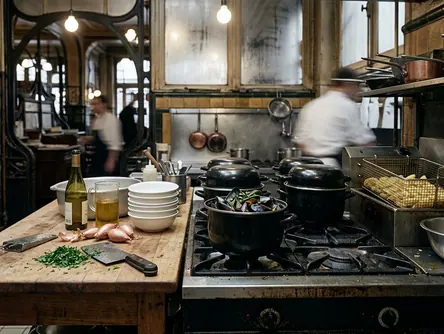
Spend 2–3 minutes on places guests touch: handles, seat edges, fitted partitions and transitions between woodwork and floor. Old fitted wood usually carries coherent wear. Faux-vintage interiors often reveal uniformly distressed panels, machine-cut ornament, modern screws or surface-mounted wiring that interrupts the supposed period scheme.
Regional heritage controls govern work on protected Brussels buildings, and the UNESCO account of Victor Horta’s major town houses illustrates the preservation standards required for historic buildings. Scope remains crucial here: a protected address does not automatically contain a protected original restaurant interior. The legal record may cover the entire building, only the façade, selected rooms or individual decorative components.
A restored room can look exceptionally crisp. Judge continuity rather than expecting every surface to appear old.
How to Evaluate a Brasserie’s Seafood Platter
A plateau de fruits de mer exposes handling discipline in plain sight. Assess it in order: activity at the écailler station, temperature and drainage, aroma, shell condition, then the texture of individual pieces.
Read the Ice First
The crushed ice should form a stable bed roughly 3–5 centimetres deep beneath the shellfish. Good drainage keeps oysters and cooked crustaceans above diluted meltwater. Fresh seaweed can steady and dress the arrangement, but it should feel damp and smell marine rather than slimy. Seaweed is presentation evidence, not proof of freshness.
Read the Ice
A towering platter can still be poorly handled. Check the cold bed at shell level, where drainage and temperature matter more than the height of the display.
Inspect the Shellfish
- Creuses: A freshly opened cupped oyster holds clear liquor, smells cleanly marine and retracts slightly at the mantle when touched with a fork. Dry, cloudy, gaping or sharply sour-smelling specimens should go back.
- Langoustines: Look for glossy shells, firm segmented tails and a mild sea aroma. Soft tail meat, extensive blackening around the head or a strong ammonia smell indicates deterioration, even under heavy ice.
- Whelks: They should arrive chilled and clean-smelling, with a firm rather than collapsing texture.
The visible écailler station deserves close attention. During service, the shucker should be opening oysters to order, replenishing crushed ice and removing shell debris. A spotless but unattended counter lined with pre-opened oysters demonstrates display preparation, not turnover.
Season affects what belongs on the platter. Availability, mussel size and edible yield shift with origin and production cycle, so a modest seasonal specimen can eat better than a larger shell chosen for appearance alone.
How to Order Traditional Moules Frites in a Historic Setting
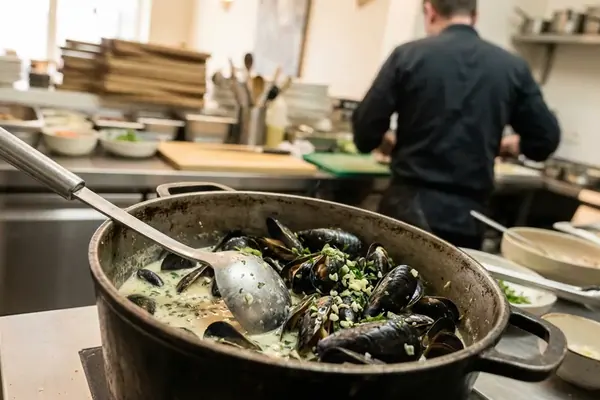
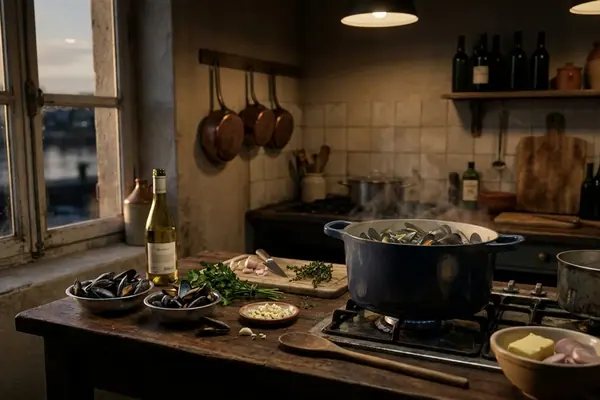
Choose the preparation that leaves the mussels easy to assess. Marinière keeps the liquor focused on onion or shallot, celery, herbs and steam. Vin blanc introduces acidity while preserving the shellfish’s natural flavour. Dense cream sauces and elaborate modern garnishes make freshness harder to read.
Many brasserie menus describe mussels by a shell-on pot weight near 1 kilogram. Confirm whether the listed weight is intended for one person, since edible yield changes with shell size and season. Mussels cook quickly, commonly in 5–8 minutes in a covered pot, and should arrive plump with enough aromatic liquor to remain moist.
- Open the pot and check for a clean, savoury aroma. Stop eating if a persistent sour or ammonia-like smell rises from the broth.
- Take the first empty paired shell by its hinge.
- Squeeze its two halves around the next mussel and lift the meat directly to the mouth.
- Place spent shells in the spare bowl or upturned lid provided.
- Keep the frites in their separate dish and dip them individually so they stay crisp.
Set aside mussels that remain firmly closed after cooking rather than forcing them open. In a formal room, the shell-as-pincer method is entirely at home; it is tidy, traditional and more controlled than working through the pot with a fork.
How to Navigate Brasserie Etiquette and Pairings
A historic brasserie moves at a deliberate tempo. The aperitif may occupy 10–20 minutes, a shellfish starter 20–35 minutes, and mussels or another hot main course 30–45 minutes. Career waitstaff often manage several tables through this rhythm, so concise ordering produces better results than repeated attempts to hurry each stage.
Match the Drink to the Dish
- Raw oysters or a cold platter: Choose a dry, high-acid white wine served around 8–10 degrees Celsius. Excessive chilling suppresses aroma; a warm bottle makes briny shellfish feel heavier.
- Marinière or vin blanc mussels: A crisp white follows the acidity and herbs in the cooking liquor.
- Frites and savoury broth: A restrained Belgian blonde has enough freshness for the fried potatoes without dominating the mussels.
- Rich shellfish: Dry gueuze brings acidity and strong carbonation. A 250–375 millilitre bottle is often enough for one diner alongside a substantial shellfish course.
Order With Clarity
Tell the server the intended spend per bottle, then name the dish: raw oysters, cold platter, marinière mussels or a cream-based preparation. That information is more useful than asking broadly for “something good with seafood.”
Keep the napkin on the lap, use the bowl or lid for empty shells and wait until the shellfish tools have been cleared before ordering coffee. Formal service responds well to direct signals: close the menu when ready, state the full order together and ask practical questions about preparation without turning the exchange into a test.
The Brasserie Experience in Practice
At about 19:45, the room begins to fill. Silver taps more frequently against porcelain, and warm electric light draws amber and green from the stained-glass skylight. At the table, a chilled langoustine cracks cleanly at its joints. The head twists free; a press along the underside releases firm, cool tail meat. For a moment there is cold shell against the fingers, saline sweetness on the tongue and warm light moving across curved woodwork as the evening service gathers around the table.


Comments
Start the discussion.
Join the Discussion