
The Stakes of Seafood Selection in Brussels
Place Sainte-Catherine is Brussels’ seafood epicenter, but the address alone guarantees nothing. Choosing carefully can produce the full grammar of Belgian cuisine: cold oysters, steaming mussels, crisp frites and a broth sharpened with celery, parsley or white wine. Choosing carelessly can mean an expensive pot of rubbery shellfish served by a terrace that trades on location.
I treat the square and its adjoining quays as a compact inspection zone. Allow 10–15 minutes to compare two or three menus around Place Sainte-Catherine, Quai aux Briques and Quai au Bois à Brûler before accepting an invitation from the first waiter holding out a menu. Check the seafood displayed outside, then verify that the printed list gives the same dishes, preparations and origins.
Before Choosing a Seafood Table
- Compare at least two menus before sitting down.
- Prefer a focused seafood list with named origins or changeable chalkboard dishes.
- Ask one concrete sourcing question and listen for a precise answer.
- Choose oysters by origin, type and texture rather than asking for the undefined “best” option.
- Confirm delivery and availability with the restaurant when freshness is the deciding factor.
In this Article
- The history of the old Vismet
- A four-pass check for seafood restaurants
- How to order oysters at an écailler
- Choosing and eating moules-frites
- Timing a visit around turnover and deliveries
- Dusk at the former fish market
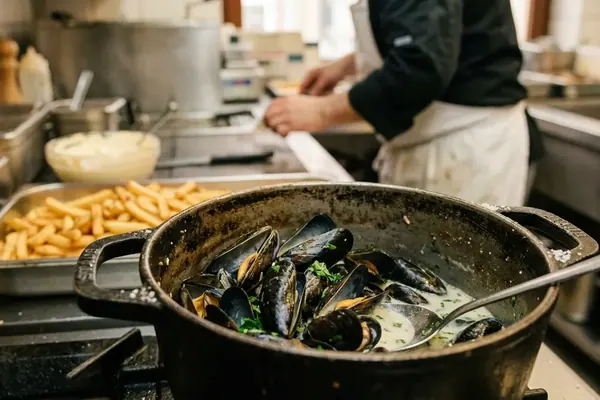
A standard moules-frites order commonly arrives in a pot holding roughly 1 kilogram of shell-on mussels, although kitchens set their own portion conventions. That is too substantial an order to make on the strength of a crowded terrace alone.
Tracing the Roots of Brussels’ Premier Seafood Hub
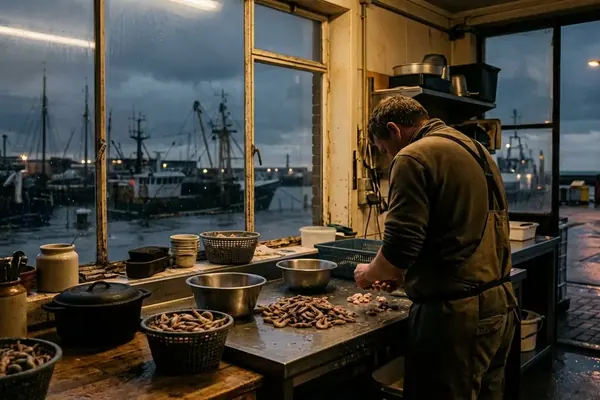
The neighborhood becomes easier to read once its long streets are understood as former waterways. During the nineteenth-century redevelopment of Brussels’ inner-port district, working basins gave way to streets and public space. Names including Quai aux Briques and Quai au Bois à Brûler preserved the old port geography after the water disappeared.
Fish trading remained associated with the district, forming the Vismet identity that still shapes its restaurant frontage. The seafood quarter lies approximately 700–900 metres northwest of the Grand-Place, an easy 10–15 minute walk today but historically a separate port-and-market district. The historical context of the Vismet helps explain why oyster counters, fish restaurants and brasserie dining remain concentrated here.
The old Vismet identity does not mean seafood is landed beside Place Sainte-Catherine today. Modern catches reach restaurants through refrigerated wholesale and supply networks. References to the former port explain the commercial district’s origin, not a current dock-to-table route.
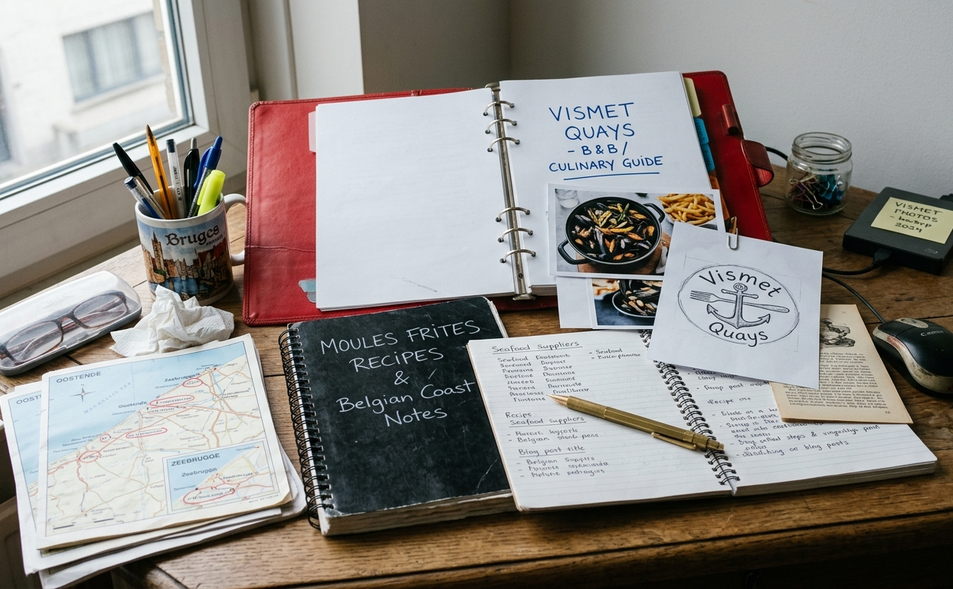
The continuity lies in trade, menu vocabulary and preparation. Shellfish cooked in aromatic liquor, raw oysters opened to order and mussels served in lidded pots fit naturally into a neighborhood whose dining rooms developed around fish commerce. The street plan supplies the historical evidence; the plates carry the culinary memory.
Spotting Authentic Quality Among Tourist Menus
A useful street assessment takes two passes: spend 3–5 minutes outside, then about 2 minutes asking one sourcing question. The goal is not to identify a supposedly secret local address. It is to establish whether the kitchen actively manages seafood whose availability, origin and condition can change.
A Four-Pass Street Check
- Read the range. Look for a short seafood list on which species, origin or preparation can change independently. A menu covering mussels, oysters, lobster, steak, pizza, pasta and waffles across several laminated pages is a risk signal because those foods require different purchasing and holding routines. It is not proof of poor cooking.
- Compare chalk with print. A handwritten board matters only when it differs meaningfully from the permanent menu. A chalkboard that merely copies a fixed tourist list says little about supply.
- Look for seasonal specificity. North Sea grey shrimp, Crangon crangon, may appear as crevettes grises, grijze garnalen, shrimp croquettes or tomates-crevettes. The useful signal is not the French or Dutch wording but whether staff can identify what is being served.
- Ask one narrow question. “What is the origin of today’s oysters?” works better than “Is the seafood fresh?” A precise place, type or delivery answer is informative. A rehearsed assurance is not.
Do not use occupancy as a quality score. A quiet room at 18:00 can reflect deliberate early arrival, while a packed terrace may owe more to sunshine and foot traffic than exceptional cooking.
Observe the dining room for local habits rather than imagined local faces. Pots arriving in steady succession, staff handling shell waste cleanly and changing specials that match the spoken offer provide more useful evidence than décor. Authenticity here is operational.
Selecting the Best Oysters and Street-Side Catches
At a standing oyster bar, or écailler, start with texture. Zeeland flat oysters have a rounder shell, firmer bite and mineral finish. Creuses offer a different shell shape and eating texture. Ordering three flats and three creuses creates a practical six-oyster comparison without committing to a dozen.
How to Place the Order
- Ask which origins and types are being opened that day.
- State whether you want a firmer mineral oyster or a creuse.
- Choose the grade, remembering that creuse numbers run inversely.
- Request the oysters unadorned first; lemon or seasoning can follow after tasting the liquor and flesh.
French-market creuse grading is precise: No. 5 weighs 30–45 grams, No. 4 weighs 46–65 grams, No. 3 weighs 66–85 grams, No. 2 weighs 86–110 grams and No. 1 weighs 111–150 grams per oyster. The number describes size, not an automatic quality hierarchy. A smaller oyster may suit a quick, bright tasting; a larger shell gives more volume and a longer mouthful.
Use smell and movement as immediate checks. A freshly opened oyster should smell saline and marine, and its flesh should react slightly when touched with the tip of a fork. Reject one with a strongly sulphurous or putrid smell.
Pair six oysters with a 10–15 centilitre pour of dry white wine or a 25–37.5 centilitre bottle of gueuze. Gueuze contributes brisk acidity and carbonation. Taste it after the plain oyster rather than pouring beer into the shell.
At a busy counter, order by origin and grade, watch the oyster being opened, and eat it within a few minutes before the liquor warms or spills. That small sequence does more for the tasting than an elaborate garnish.
Mastering the Traditional Moules-Frites Order
The broth determines how clearly the mussel itself comes through. Marinière commonly centres on celery, onion or shallot, parsley and cooking liquor, producing the clearest shellfish profile. Vin blanc adds dry white wine and a more pronounced acidic, vinous edge. À la crème finishes the liquid with cream, giving the broth greater richness and weight.
For a first comparison, marinière is the most revealing order. Vin blanc suits diners who want brightness, while à la crème shifts attention toward the sauce. None requires a complicated eating ritual, but the Belgian shell technique keeps the meal tidy.
The Shell-as-Tweezers Technique
- Eat the first mussel with a fork.
- Keep its empty shell and hold the two halves like hinged tweezers.
- Use that shell to grip and extract the meat from each subsequent mussel.
- Place empty shells in the upturned lid of the pot, not back in the broth.
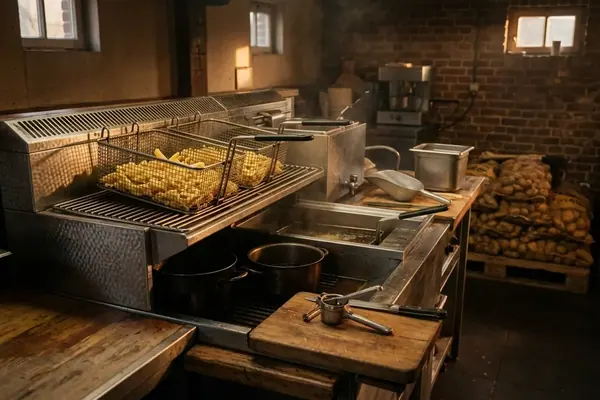
The separate serving of frites protects their crisp exterior. Dip one fry into the upper broth immediately before eating it. Leaving a handful submerged for even 30–60 seconds softens the crust and draws excess sediment from the bottom of the pot. The pleasure lies in the contrast: crisp potato, hot liquor and the saline sweetness of the mussel.
An unopened shell after cooking is not, by itself, a reliable safety test. Do not force it open and eat it automatically. Ask for it to be removed or replaced, then judge the meal through smell, handling and the kitchen’s overall care rather than one folk rule.
Strategic Timing for Peak Seafood Freshness
Plan around turnover and confirmed deliveries, not a universal claim that one weekday is always freshest. Contact the restaurant earlier that day and ask when the mussels or oysters arrived. Then choose the first service after that delivery when practical.
A useful low-pressure arrival window is 11:45–12:15 for lunch or 18:00–18:45 for dinner. The busiest central-Brussels periods commonly develop after 12:30 and 19:30. Early service leaves more time to discuss oyster origins, compare preparations and secure a table before terrace demand accelerates.
Match the Visit to the Product
- Zeeland bottom-cultured mussels: Their main season generally begins in July and extends into April, subject to growth, meat content and harvesting decisions.
- Rope-grown mussels: These can appear from late spring and may extend the practical ordering calendar.
- Friday or Saturday dinner: Reserve 2–5 days ahead when a particular dining room matters.
- Same-day plans: Standing counters and the beginning of service offer more realistic flexibility.
Delivery days, opening hours and mussel availability differ by supplier and restaurant. For this district, a direct confirmation is more dependable than a fixed Monday-versus-Tuesday rule. This is one of the few moments when a short phone call provides better evidence than another online list.
Dusk at the Old Fish Market
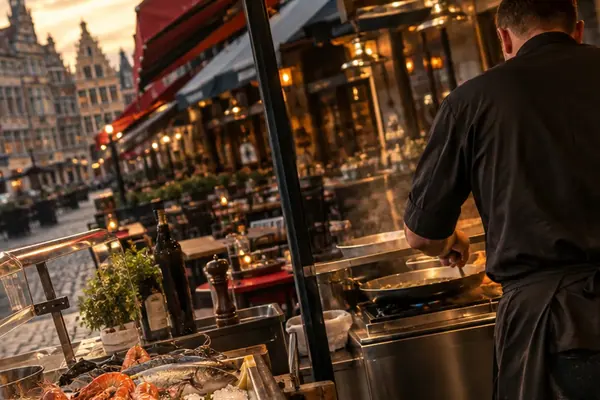
Arrive before the evening rush and take a place at a zinc counter facing the Church of St. Catherine. Order one oyster by its stated origin and watch the knife work around the hinge. The top shell lifts; the oyster remains in its clear liquor, cold enough to mist the edge of the tray.
Around local sunset, the transition from daylight to illuminated awnings lasts roughly 20–35 minutes, though the clock shifts with the Brussels season. In that brief interval, glasses begin to clink behind the counter, the terraces fill, and a salty marine aroma rises above the warmer scent of mussel broth.
The oyster is eaten within minutes of opening. Across the short walk, the zinc counter, church façade, former fish-market quays and glowing restaurant awnings sit in one frame. A server clears the shell, another bottle of gueuze opens with a soft pop, and the square settles into dinner service.

Comments
Start the discussion.
Join the Discussion