Discover the best authentic restaurants near Grand Place in Brussels. Avoid tourist traps and find traditional Belgian seafood and local culinary gems.
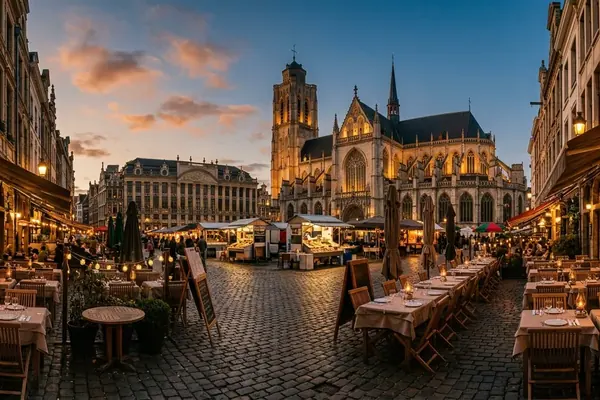
Dining beside Grand Place can be glorious, but the square is not a neutral place to choose dinner. The buildings do half the selling before a waiter says a word.
I rank restaurants here by walking friction first, then by visible Belgian specialization. That sounds cold for a meal built around steam, butter, beer, and frites, but it keeps you from paying for a postcard when what you wanted was a serious pot of mussels.
In this Article
Key Takeaways for Dining Near Grand Place
The Grand Place Dining Scene: What to Expect
Spotting Tourist Traps vs. Authentic Eateries
Seafood and Moules Frites: Where to Find the Best
Traditional Belgian Brasseries Just a Short Walk Away
Limitations of Dining in the Historic Center
Key Takeaways for Dining Near Grand Place
Best search radius for authentic Belgian dining
The most practical authenticity radius is hovering around a 3- to 7-minute walk from the center of Grand Place, roughly 250 to 600 meters depending on cobbles, crowds, and whether your route cuts through the Galeries. Directly on the square, convenience is unmatched. Authenticity becomes more plausible once you leave the ceremonial frontage and read the smaller streets with a cooler eye.
Within about five minutes, start with mussel-focused Belgian brasseries on the streets immediately north and northeast of the square. Before committing, compare them against quieter side streets west of the square. That small detour often separates a kitchen selling Belgian food from a frontage selling Belgium as scenery.
Fast brasserie checklist
Mussels appear in a short, classic range: marinière, crème, vin blanc, garlic, or a beer-based sauce.
The menu has a Belgian center of gravity: moules-frites, shrimp croquettes, carbonnade, waterzooi, or regional beer pairings.
Fries arrive separately: in a cone, basket, or bowl, not drowned beside the shellfish.
Service hours make sense: lunch around 12:00 to 14:00 or 14:30, dinner from about 18:30 to 22:00.
The facade does not shout too much: a chalkboard and a compact printed menu beat a wall of laminated promises.
Recommendation: If you want traditional moules-frites within about a five-minute walk, choose the brasserie with the shortest mussel list, the busiest pot turnover, and no doorway pressure. The dish rewards focus more than theatricality.
Best quick dinner window
A normal dinner decision window in the historic center is roughly 18:30 to 21:30. After about 22:00, the open choices near the square lean more toward visitor traffic than careful seafood service. I would rather eat early at a disciplined brasserie than late at a place still promising every seafood preparation on the board.
The Grand Place Dining Scene: What to Expect
Three layers of restaurants
The area works in three dining layers. First comes the ceremonial square, where the view carries real value. Behind it sit the restaurant lanes, including streets with long seafood histories and a heavy visitor flow. A short walk beyond those lanes brings you to seafood-oriented neighborhoods where the menu often matters more than the photograph.
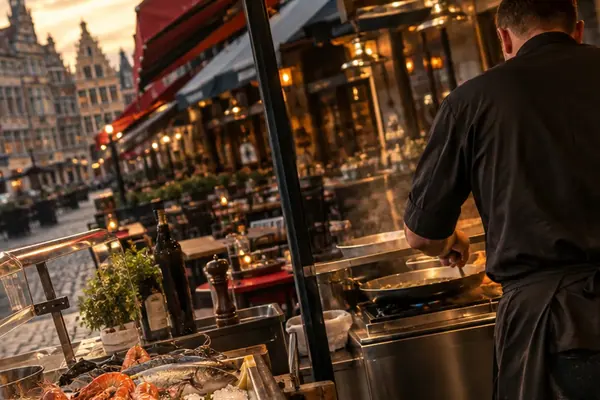
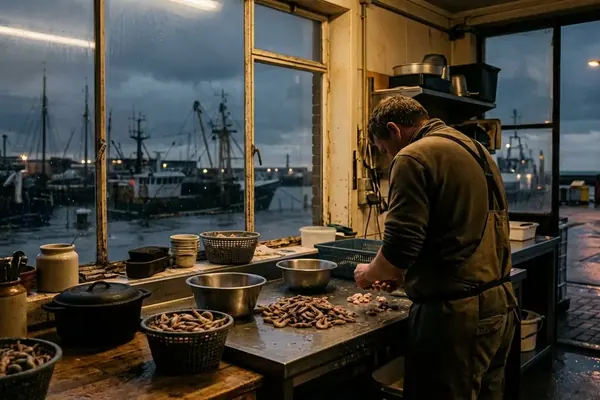
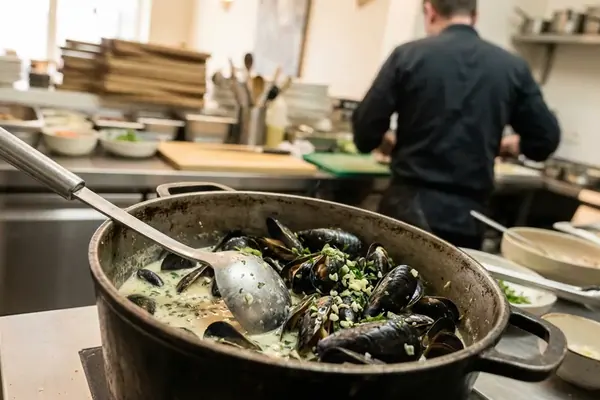
This structure explains why two restaurants only minutes apart can feel as if they belong to different cities. One sells a terrace seat under gilded guildhall facades. Another sells steam rising from a black mussel pot, a bowl of frites, and a waiter who assumes you know what mayonnaise is for.
Architecture as part of the bill
Grand Place was added to the UNESCO World Heritage designation in 1998. That matters at dinner. Restaurants here do not operate in ordinary retail shells; they work inside a protected historic stage where terraces, storefronts, and views shape the price before the kitchen begins.
The guildhall frontages largely reflect the rebuilding period after the 1695 bombardment of Brussels. Many nearby dining rooms are narrow and vertical rather than broad and modern, so service can feel compressed: tight stairs, stacked rooms, small kitchens, quick table resets. None of that is automatically bad. It is part of eating in the old center.
Why the square costs more
A guest paying for a seat directly on the square is often paying for the view, terrace logistics, and high-rent location. Comparable moules-frites a few streets away is commonly listed in a lower band by several euros per main course. That is not a scandal; it is the price of choosing architecture as an ingredient.
Expect the densest foot traffic from roughly 11:30 to 14:30 and 18:00 to 21:30, especially during dry weekends and school-holiday periods. Terrace turnover accelerates then, and the rhythm of the meal can become brisk. If you want a slower seafood dinner, step away from the square before you sit down.
Spotting Tourist Traps vs. Authentic Eateries
Read the facade before the reviews
A traveler near Grand Place usually has to decide in minutes, not after an evening of research. Facade behavior tells you a great deal. Watch the host, the menu board, the dishes leaving the kitchen, and the way the restaurant explains itself to passersby.
The strongest warning sign is not translation. A restaurant with a multilingual menu can still be legitimate near Grand Place because visitor-heavy neighborhoods require translation. The stronger warning sign is a multilingual picture menu combined with street solicitation, an unfocused global menu, and no visible Belgian seafood discipline.
Red flags worth taking seriously
A frontage board offering moules, paella, pizza, steak, pasta, burgers, waffles, and cocktails with equal confidence.
Picture menus in the ballpark of five to eight languages paired with a host steering pedestrians into the room.
A full seafood menu promised continuously from late morning to midnight.
No visible Belgian beer focus, no regional dish language, and no sign of mussel pots moving from kitchen to table.
Shellfish promoted heavily outside the strongest seasonal window without any seasonal language.
Risk: The trap is often operational, not decorative. A pretty old building can still house a careless kitchen, while a plain facade can hide a very competent brasserie.
Green flags for Belgian brasseries
Look for localized menus, seasonal chalkboards, and a clear commitment to regional Belgian specialties. A compact printed menu with a chalkboard supplement is usually more convincing than a laminated booklet trying to feed every possible craving.
For mussels, I watch for a short list of sauces, covered pots leaving the kitchen, and fries served separately so they stay crisp. The room should smell like broth, celery, onion, parsley, wine, pepper, and hot potatoes. It should not smell like a seafood counter left too long under lights.
Local dining hours as a diagnostic tool
Authentic local dining hours, according to local expertise, cluster around lunch from 12:00 to 14:00 or 14:30 and dinner from about 18:30 to 22:00. A restaurant open outside those hours may still feed you well, but if it promises the entire seafood card without pause, inspect more carefully. Kitchens that never narrow their offer often narrow their standards instead.
Seafood and Moules Frites: Where to Find the Best
Rue des Bouchers is a mixed zone
Rue des Bouchers deserves a sharper reading than “go” or “avoid.” Its reputation comes from both genuine historic seafood dining and highly theatrical visitor traps. On the same evening, the street can produce a satisfying pot of moules marinières and a tired plate aimed at someone who will never return.
The reliable distinction is not the street name. It is the kitchen signal: short mussel menu, hot covered pots, separate fries, seasonal seafood language, and no pressure from the doorway.
What proper Moules Marinières should look and smell like
A properly served pot of Moules Marinières should arrive hot and covered. When the lid lifts, the steam should carry white wine, celery, onion, parsley, and black pepper. Heavy cream has its place in other preparations, but it should not mask the core marine sweetness of marinière.
The serving should be a deep pot rather than a flat plate. Fries belong on the side, with mayonnaise commonly offered separately. This is not fussiness; it is engineering. Shellfish throws broth, broth softens potatoes, and softened frites lose the point of being frites.
Mussel handling that signals care
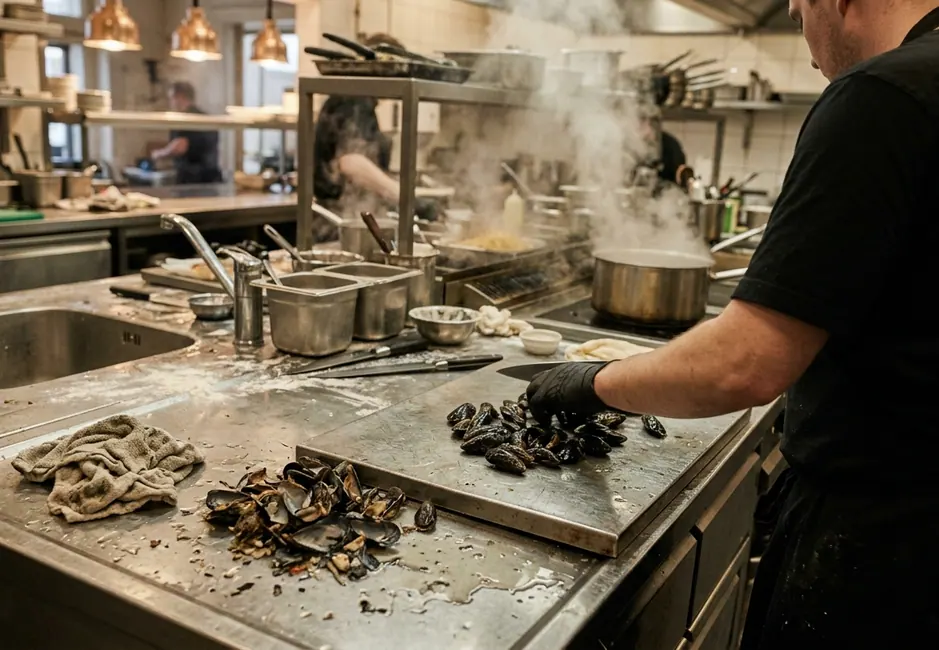
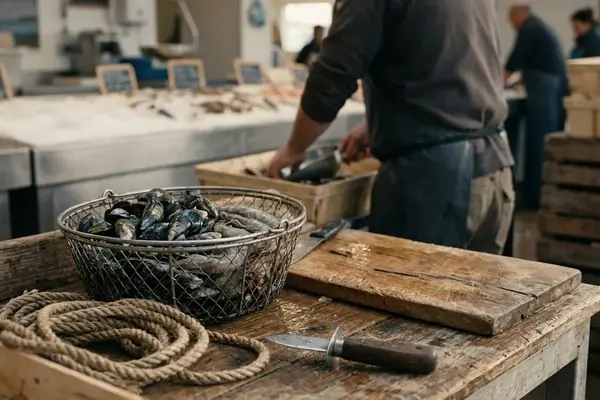
Good kitchens reject cracked, unusually heavy, or persistently open raw mussels before cooking. They also discard mussels that do not open after cooking. As a diner, you should not see a pile of broken shells at the bottom of the pot.
Mussels are strongest when sourced during the main North Sea and Zeeland-style season, which usually begins in mid-summer and runs into spring depending on harvest conditions. A brasserie that treats seasonality as part of the dish earns more trust than one that presents mussels as a year-round prop.
Kitchen note: The best moules-frites near Grand Place usually tastes simple because the kitchen has already done the strict work: sorting, rinsing, timing the pot, and keeping the fries dry until they reach you.
Traditional Belgian Brasseries Just a Short Walk Away
When to leave the postcard core
Traditional Belgian seafood often expresses itself better in rooms that do not need to sell the Grand Place view. If you are willing to walk beyond the strict five-minute radius, the calculation changes. Place Sainte-Catherine is roughly a 9- to 13-minute walk from Grand Place, which puts it just outside the quick-search zone but firmly inside a sensible dinner plan.
That extra distance can trade view-driven pricing for kitchen-driven pricing. It also gives you breathing room: fewer people stopping mid-step for photographs, more tables that feel arranged for dinner rather than turnover.
Beer pairings with coastal dishes
Belgian beer pairing is not about choosing the strongest bottle on the list. For mussels, dry blond ales, wheat beers, and gueuze-style sour beers tend to keep the broth clean and the shellfish bright. Stronger dark ales can overwhelm delicate marinière broth, though they can suit richer cream or beer-based sauces.
If the waiter asks which mussel preparation you ordered before suggesting a beer, take that seriously. It means the pairing is being made around the pot, not around the highest-margin bottle.
Brasserie atmosphere that earns its keep
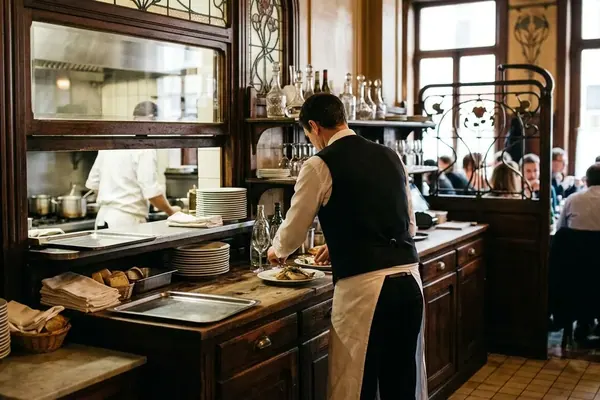
Historic brasserie cues are tactile: tiled floors, banquettes, mirrors, wood paneling, brass rails, zinc bars, and menus that know when to stop. These rooms do not need theatrical clutter. The best ones feel used, not staged.
Seafood brasseries serving both locals and visitors tend to fill between about 19:30 and 20:30 on Fridays and Saturdays. A same-day reservation before about 16:00 is materially safer than walking in at peak dinner time, especially if you care where you sit. The corner table under the mirror is rarely waiting for the most hesitant person on the pavement.
Limitations of Dining in the Historic Center
Value is rarely strongest on the square
The absolute best value-for-money is usually not on Grand Place itself. Moving roughly 400 to 900 meters away can change the equation from view-driven pricing to kitchen-driven pricing. This does not make the square a bad choice; it makes it a specific choice.
If you want the guildhall view, pay for it knowingly and order simply. If you want the most convincing seafood meal, let the streets pull you outward.
Peak periods change the meal
Peak pressure is most visible during late spring weekends, summer travel months, December holiday-market periods, and dry evenings when terraces are full. Service speed changes then. Reservation availability tightens. Menus that look manageable at around 18:30 can feel strained by about 20:15.
Reservation risk rises for dinner between roughly 19:00 and 21:00, especially for groups of four or more. Couples have more flexibility at 18:30 or after about 21:15. That late slot can work well for brasserie classics, but I would be more cautious with seafood after the main rush unless the kitchen still looks disciplined.
Scope of this guide
This guide covers traditional Belgian brasseries and seafood restaurants near Grand Place. It favors moules-frites, shrimp croquettes, classic Belgian beer pairings, and old-room brasserie culture. It does not try to judge international fast-casual dining, modern fusion menus, dessert-only stops, vegan tasting menus, late-night cocktails, or the lowest possible meal price.
That boundary is intentional. The guidance is strongest for travelers seeking Belgian seafood and brasserie meals; it is less useful for diners building an evening around other priorities. Grand Place can be everything at once if you let it. Dinner improves when you ask it to be one thing, then choose the street that serves that thing best.

Comments
Start the discussion.
Join the Discussion