
North Sea Wind, Golden Crust, Clear Verdict
The wind coming off the North Sea has a way of finding every gap in a coat. On the Ostend promenade, that cold disappears for a moment when a grey-shrimp croquette splits beneath a fork. The crust cracks cleanly. Steam rises from the salpicon, carrying the concentrated aroma of shellfish, and the small shrimp remain visible as the filling loosens across the plate.
For the defining Belgian grey-shrimp croquette, take the train from Brussels to Ostend. Brussels has serious seafood restaurants and kitchens capable of excellent croquettes. The coastal advantage, however, begins with the ingredient chain: catch, onboard cooking, cooling, landing, peeling, shell stock, filling, resting, breading and frying. Ostend gives a cook a realistic chance to compress those stages.
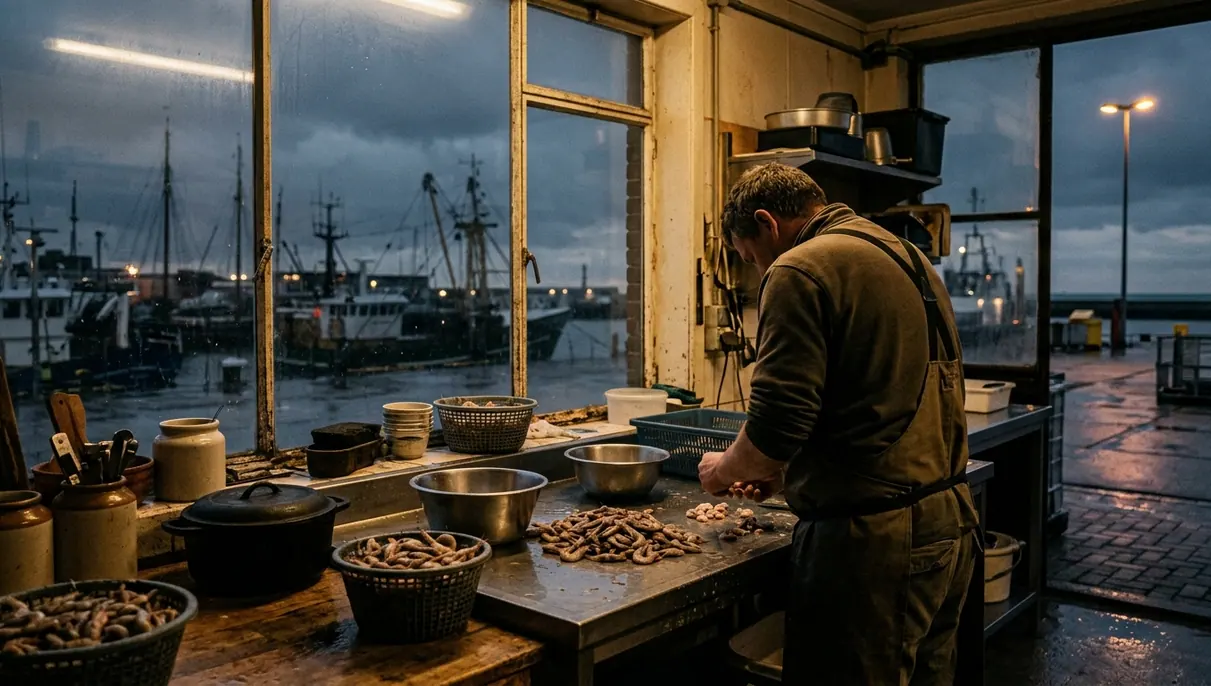
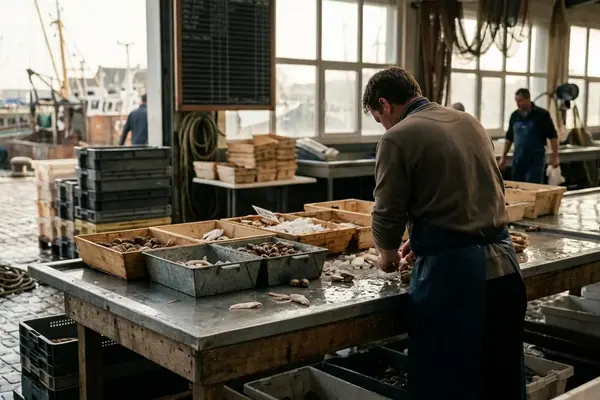
Grey shrimp are normally boiled aboard the fishing vessel, then cooled and landed before peeling. When the shells enter a stockpot during the same preparation cycle, they still carry the aroma needed for a deep bisque. The peeled shrimp also retain their gentle snap. A longer chain introduces more refrigeration, transport and handling before either component reaches the kitchen.
Follow The Chain
The landing-to-peeling-to-shell-stock-to-salpicon sequence separates an Ostend grey-shrimp croquette from a merely seaside breaded snack.
I judge the first cut before adding lemon. A good crust should be brittle rather than hard, while the steaming center should relax after opening. Distinct shrimp should sit throughout the salpicon instead of disappearing into a smooth paste. That contrast tells more than the view from the dining room.
The journey also makes practical sense. A direct InterCity train from Brussels-Midi to Oostende generally takes about 1 hour 10 minutes to 1 hour 25 minutes, depending on the departure. For culinary travel, that is a modest commitment to reach the point where Belgian cuisine meets its raw material.
Inside a Proper Ostend Shrimp Croquette
The key ingredient is Crangon crangon, the North Sea grey shrimp often called the “caviar of the North Sea.” It is small, earthy and gently sweet, with more character than its size suggests. A croquette succeeds when the cook preserves that character through three separate layers: shrimp, salpicon and crust.
Shrimp That Stay Distinct
Density matters. Cutting through the croquette should reveal shrimp distributed across the filling, with enough whole pieces to produce a delicate bite. A sparse filling may smell faintly marine yet taste mainly of thickened sauce. The better version lets the shrimp lead.
Texture is equally revealing. Grey shrimp lose some of their snap through repeated cooling and extended storage. Fresh handling leaves them discernible against the creamy salpicon, creating a small but important resistance under the teeth.
Shell Stock as the Foundation
The coastal kitchen gains its strongest advantage after peeling. Heads and shells can be sweated and simmered while the shrimp meat remains chilled. A practical sequence gives the shells approximately 20 to 30 minutes in the pot, followed by fine straining. The resulting liquid becomes the flavorful component of the béchamel-style salpicon.
This approach builds depth without relying on an aggressively flour-heavy base. The filling should taste of roasted shell and sweet shrimp, with enough structure to shape once cold. Documentation from the Flanders Marine Institute places Belgian grey-shrimp fishing within the North Sea’s shallow-water environment and coastal heritage, useful context for understanding why the ingredient carries such local weight.
Rest, Crumb and Fry
Salpicon needs patience. After cooking, the mixture commonly rests under refrigeration for 8 to 12 hours before shaping and breading. That interval allows the filling to set firmly enough for handling. Once it reaches hot oil, it should return to a yielding consistency.
Frying at approximately 175 to 180 degrees Celsius for 3 to 4 minutes gives the center time to heat without driving the crumb too dark. The finished shell should fracture with a fork. After opening, the filling should soften and spread while still holding visible shrimp.
Read The Center
Wait 30 to 60 seconds after cutting. A center that retains the exact shape of the croquette usually signals heavy binding; a well-heated salpicon relaxes onto the plate.
Where Inland Croquettes Lose Their Coastal Edge
The meaningful boundary between coast and capital comes from transparent handling and a molten center, not the distance between the fryer and the North Sea. A seafront address alone says little about who made the croquette or where its shrimp were peeled. A Brussels kitchen preparing shell stock in-house can outperform an Ostend counter reheating a factory-made product.
Grey shrimp decline quickly in quality, so they are cooked soon after capture. The difficulty begins after landing. Industrial supply chains may preserve or freeze the cooked shrimp, or send them abroad for machine-assisted or lower-cost hand peeling before returning them to Belgium. Every additional cooling, transport and storage stage can soften the texture and mute the sweetness.
Local Peeling Changes Two Ingredients
Local hand peeling preserves more than the shrimp meat. It also keeps the shells close to the kitchen. A locally peeled batch can move from a morning or previous-night landing into stock and filling within a preparation window hovering around 24 hours. An internationally processed batch may spend several days under refrigerated handling before arriving in a Belgian kitchen.
That distinction affects both halves of the croquette. The meat supplies the sweet, earthy bite; the shells provide the aromatic backbone. Separating the two early in the chain leaves a cook with less expressive shrimp and shells that are less useful for fresh stock.
Questions That Expose the Preparation
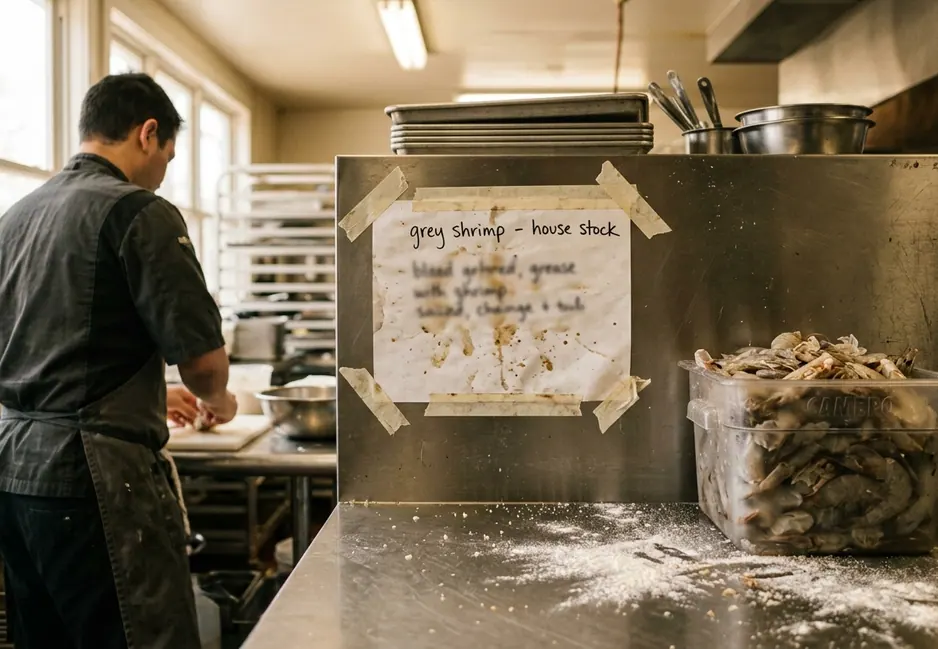
Menu language offers a first clue. “Shrimp croquette” gives little evidence. Descriptions that identify grey shrimp, house preparation or local hand peeling provide a stronger basis for ordering, though the wording still deserves a direct question.
- Are the grey-shrimp croquettes made in-house?
- Are the shrimp peeled locally?
- Does the kitchen prepare the filling with stock from the shrimp shells?
Staff who know the preparation can usually answer plainly. Vague replies suggest that the kitchen receives a finished or partly finished product. This is a sourcing screen rather than a guarantee; the cut croquette remains the final test.
Once served, look for an evenly fried crust and a center that relaxes after the steam escapes. Visible shrimp should remain distributed through the filling. The aroma should suggest concentrated shellfish, while the texture should avoid the rubbery stiffness of a heavily bound interior.
Skip Generic Claims
Choose the kitchen that can explain peeling and stock preparation over the dining room that relies on a sea view as proof of authenticity.
A Brussels-to-Ostend Croquette Day, Step by Step
Plan 6 to 8 hours for the trip. That leaves room for the direct train, a careful lunch and a harbor or promenade walk without turning the day into a race. Check the same-day timetable because stopping patterns and engineering work can alter the journey.
1. Leave from Brussels-Midi
Choose a direct IC, or InterCity, service from Brussels-Midi to Oostende. Allow roughly 1 hour 10 minutes to 1 hour 25 minutes aboard. An early-to-midmorning departure positions lunch within the useful 12:00 to 14:00 window.
2. Walk Straight to Visserskaai
Exit the striking Oostende railway station toward the harbor and follow the waterfront to Visserskaai, the Fisherman’s Quay. The near end is approximately a 5 to 10 minute walk from the station. Heading directly there avoids an unnecessary detour through the inland shopping streets.
Restaurants farther west along the promenade can add another 10 to 20 minutes on foot. Use that stretch after lunch if you want the sea air and beach frontage; begin near the harbor when the ingredient chain is the priority.
3. Inspect Before Ordering
Read the menu for “grey shrimp,” house preparation or local peeling. Then ask the two decisive questions: whether the croquettes are made in-house and whether the shrimp are peeled locally. If the kitchen also uses the shells for its own stock, the preparation follows the coastal logic described above.
4. Taste in a Fixed Order
- Split one croquette through the center.
- Wait approximately 30 seconds for the first rush of steam to escape.
- Observe whether the salpicon softens and whether whole shrimp remain visible.
- Taste the filling before using lemon.
- Add one light squeeze of lemon for the next bite.
- Alternate the remaining bites with fried parsley and a crisp blonde beer.
A Copyable Day Plan
Here is the complete run: take a direct midmorning IC from Brussels-Midi and budget up to 1 hour 25 minutes for Oostende. Leave the station toward the harbor, reach the near end of Visserskaai within about 5 to 10 minutes, and inspect menus before choosing a table. Ask about in-house production, local peeling and shell stock. Order the grey-shrimp croquettes for lunch between 12:00 and 14:00.
When the plate arrives, split the first croquette, count 30 seconds, and watch the center relax. Take one bite without lemon, then one with a light squeeze, alternating with fried parsley and blonde beer. After lunch, walk west along the promenade for 10 to 20 minutes, return toward Oostende station, and board an afternoon direct train to Brussels. The result is a focused 6-to-8-hour culinary journey built around one precise chain: landed shrimp, local peeling, fresh shell stock, rested salpicon and a croquette fried to order.


Comments
Start the discussion.
Join the Discussion