
Seven Orders That Open Up a Brussels Seafood Menu
Order only moules frites in Brussels and you leave a remarkable part of Belgian cuisine unexplored: tiny North Sea brown shrimp, eel in sharp green herbs, Ghent’s creamy fish stew, and whole sole cooked in butter. You also miss the chance to ask what the kitchen has bought for today’s service before committing to a fixed tourist menu.
I would start with brown shrimp, then choose a main by its sauce. These seven orders give a Brussels dining trip room to stretch beyond the mussel pot.
- Cold starter: tomate crevette, a ripe tomato filled with brown shrimp and mayonnaise.
- Hot starters or tavern snacks: garnaalkroketten, the classic shrimp croquettes, or sweeter croquettes de crabe.
- Comforting main: waterzooi de poisson, with fish, vegetables, and creamy broth.
- Herb-forward main: anguilles au vert, eel in green sauce.
- Butter-rich main: sole meunière, or seafood-sauced sole à l’Ostendaise.
- Thick-flaked main: cabillaud à la flamande, with the kitchen’s chosen Flemish-style accompaniments.
A daily special can reflect purchasing and kitchen preparation as much as seasonality. Ask what makes today’s fish worth ordering.
North Sea Brown Shrimp in Tomatoes and Golden Croquettes
1. Tomate Crevette: A Cold Starter Worth Inspecting
The appeal lies in the small details: a ripe, hollowed tomato, tiny peeled brown shrimp, and mayonnaise sharpened with lemon. A peeled beefsteak tomato and house-made mayonnaise are welcome refinements, though neither defines the dish.
Look for crevettes grises in French or grijze garnalen in Dutch. These are brown shrimp, Crangon crangon. Pink shrimp give a different result; establish the ingredient before judging the price.
2. Garnaalkroketten: Crisp Shell, Soft Shrimp Filling
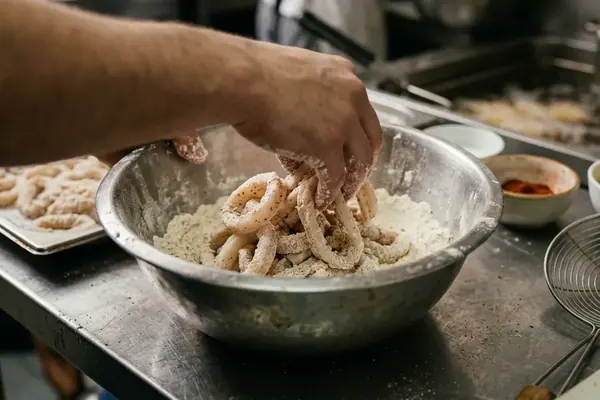
Also called croquettes aux crevettes grises, these should offer a brittle breadcrumb shell around a soft, deeply savory filling. Shrimp heads and shells flavor the stock used in the thick béchamel or salpicon; peeled shrimp provide recognizable little pieces. The filling is cooled, shaped, breaded, and fried.
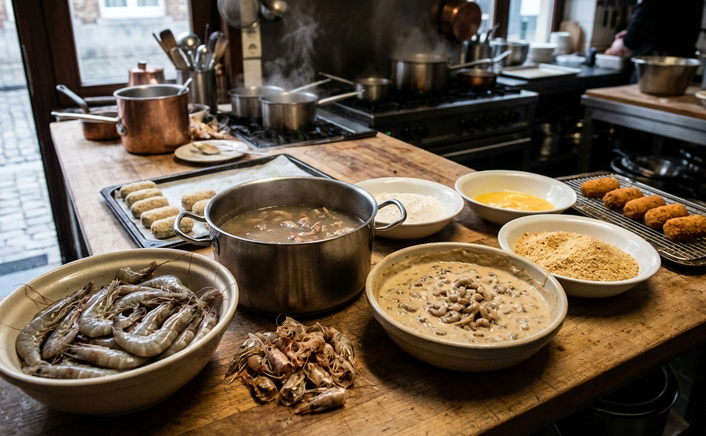
Fried parsley adds another crisp texture. Squeeze the lemon yourself so the acidity stays where you want it.
Ask Three Questions
Brown shrimp identifies the ingredient; hand-peeling identifies the processing; maison identifies kitchen production. None proves the other two. Tiny shrimp require individual peeling, which helps explain their cost. Ask about each claim separately; an irregular croquette shape proves little.
Green-Herb Eel and Ghent’s Gentle Fish Waterzooi
3. Anguilles au Vert: Choose It for the Herbs
For a more assertive plate, I would choose paling in ’t groen, the Dutch name for anguilles au vert. Associated particularly with the Scheldt region around Dendermonde, it brings firm eel flesh and gelatin-rich skin together with a concentrated green herb sauce.
Sorrel supplies acidity. Parsley, chervil, watercress, mint, and sage can contribute to the mixture, with recipes varying in balance. Expect cut sections containing the central backbone.
Hot service suits a meal with fries. Served cold, the eel’s gelatin can softly set the sauce. That texture is part of the attraction, alongside the bright herbal bite.
4. Waterzooi de Poisson: Start Here for Comfort
Ghent’s waterzooi has freshwater-fish roots, preceding the familiar chicken version. Modern fish preparations bring fish together with leeks, carrots, celery, potatoes, and creamy broth; the particular catch belongs in the ordering conversation.
A traditional egg-yolk-and-cream liaison gives the broth its velvety body. It needs gentle heat because a rolling boil can coagulate the yolk. For diners hesitant about assertive fish flavors, waterzooi offers a softer introduction than eel with sorrel.
Butter-Cooked Sole, Flemish Cod, and Sweet Crab Croquettes
5. Sole Meunière or Sole à l’Ostendaise: Read the Sauce
These names describe distinct preparations. Sole meunière is lightly floured, pan-fried, and finished with butter, lemon, and parsley. Sole à l’Ostendaise commonly comes with a white-wine or cream-based seafood sauce, mussels, and brown shrimp. Landing a sole on the Belgian coast does not make its preparation Ostendaise.
Dover sole, Solea solea, rewards careful whole-fish service. Ask whether the restaurant will fillet it at the table if you would rather concentrate on the butter than the bones.
6. Cabillaud à la Flamande: Ask What Comes with the Cod
Look for a description of thick cod loin with butter-braised leeks, white wine, chopped hard-boiled egg, and fresh herbs. Those concrete details tell you more than the name alone: cabillaud à la flamande, or kabeljauw op Vlaamse wijze, does not prescribe one uniform preparation.
7. Croquettes de Crabe: A Sweeter Alternative
Crab croquettes shift the emphasis toward sweetness. Tourteau means edible brown crab, Cancer pagurus; white meat gives a delicate filling, while brown meat brings a more pronounced flavor. Ask whether the kitchen adds cayenne or Cognac rather than assuming either belongs in every batch.
This is an ordering guide rather than seven equally canonical recipes: crab croquettes have a weaker claim to Belgian-classic status than brown-shrimp croquettes.
Ask About Production, Set the Sole Price, Then Choose Your Beer
For culinary travel, a few precise questions earn their place beside any seafood guide. Work through them before ordering:
- Check production. Ask “Les croquettes sont-elles faites maison?” or “Zijn de kroketten huisgemaakt?” For brown shrimp, use “Ce sont des crevettes grises de la mer du Nord?” or “Zijn dit Noordzeegarnalen?” Ask separately about hand-peeling.
- Set the price. Prix du jour means you need today’s figure. Ask “Quel est le prix de la sole aujourd’hui?” or “Wat kost de zeetong vandaag?” Establish whether the charge covers a fish, a portion, or a weight.
- Pair against the sauce. Dry traditional geuze brings acidity to fried crumbs and butter. Tripel contributes carbonation, fruity fermentation character, bitterness, and alcoholic weight. Oud bruin offers malt and sweet-sour notes; sweetness varies by producer.
Those tiny shrimp also carry a coastal story. At Oostduinkerke, fishers still ride Brabant draft horses through shallow seawater while drawing shrimp nets. The UNESCO Intangible Cultural Heritage listing for Oostduinkerke horseback shrimp fishing records the tradition’s inscription in 2013: a place on the world’s cultural heritage list for catching the shrimp that can fill a Brussels tomato.
Comments
Start the discussion.
Join the Discussion