
From Rue des Bouchers to Brussels’ Residential Mussel Tables
Post-war tourism and Brussels’ 1958 international exposition helped expand the historic center’s visitor economy. That history deserves a little precision: Rue des Bouchers takes its name from the butcher trade. Calling it a former working-class seafood market, then describing local diners fleeing outward, turns a neighborhood guide into an unsupported origin story.
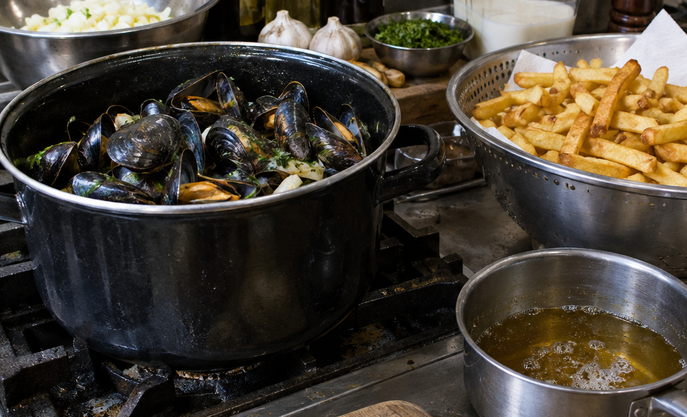
I would start a mussel evening with three questions: Where does this week’s supply come from, how is the portion served, and how are the fries cooked? Dutch bottom-cultured mussels conventionally run from approximately July through April, with the opening dependent on meat development and producers’ schedules. An individual enameled pot makes practical sense; enameled steel is common, and cast iron earns no special authenticity points. Double-fried potatoes cooked in beef fat provide a traditional Belgian accompaniment.
These checks reveal more than a picturesque address.
- Ixelles: choose established brasseries and dining around Flagey and the ponds.
- Saint-Gilles: look around the parvis for café terraces and neighborhood bistros.
- Schaerbeek: use Place Colignon as an orientation point for a residential outing.
- Watermael-Boitsfort: plan a greener excursion with time for a tavern meal.
Brussels-Capital comprises 19 municipalities; these four are municipalities in their own right. This is a planning framework rather than a current restaurant audit: confirm menus and kitchen hours before travelling. For wider culinary travel planning, Brussels' official municipal dining heritage offers a useful starting point alongside the restaurant’s own information.
Ixelles: Plan Around Flagey, the Ponds and Châtelain
I divide Ixelles into dining pockets before looking at menus. Flagey and the ponds make one outing; Châtelain and Avenue Louis Lepoutre deserve a separate address check. Treating them as a continuous restaurant strip makes an evening feel longer on foot than it looked on a map.
Bus 71 connects central Brussels with Flagey through the Porte de Namur area. The Ixelles Ponds begin immediately south of Place Flagey. Allow roughly 15–25 minutes to walk between Flagey and the Châtelain dining area, depending on the streets and the actual restaurant address.
Read the Brasserie Beyond Its Tablecloth
For an Art Deco brasserie evening, inspect the room and the menu separately. White paper over linen and brisk service can suit the occasion beautifully; neither establishes what happens in the kitchen. With marinière, look for the familiar combination of white wine, onion or shallot, celery and parsley. Steaming releases substantial mussel liquor, so a heavily reduced, wine-dominant sauce is no benchmark.
Book Without a Belgian Number
- Confirm that the restaurant serves dinner, and that mussels appear on its current menu.
- Choose a Thursday or Friday date, a specific time and the number of diners.
- Use the restaurant’s own reservation form or email. Enter a reachable telephone number in international format if requested.
- Ask for written confirmation, including whether the table has a return time.
“Bonjour, avez-vous une table pour deux jeudi à 19 h? Mon numéro est étranger; pouvez-vous confirmer par e-mail?”
That request supplies the essentials: a table for two on Thursday at 19:00, an overseas number and a request for email confirmation. Keep the reply accessible when you arrive.
Saint-Gilles: Match the Parvis Atmosphere to the Broth
The Parvis de Saint-Gilles concentrates market activity and café terraces. Walk uphill toward Barrière de Saint-Gilles and the neighborhood becomes more residential; the journey takes roughly 10–15 minutes. Hôtel des Monnaies forms another nearby pocket, rather than the endpoint of that same climb.
Choose the surroundings first. A terrace-facing meal around the parvis and a quieter table farther uphill answer different appetites for an evening out.
Ask What Enriches the Pot
When comparing richer preparations, read the sauce names closely. Moules à la crème indicates cream enrichment; à l’ail signals garlic. For beer-steamed mussels, ask which beer goes into the pot, or at least its style. “Belgian beer” alone tells you little about sweetness, bitterness or acidity.
I choose the broth before the drink. Cream changes the weight of the meal; garlic stays with the palate; a beer preparation needs enough detail to judge what will sit comfortably beside it. An artisanal label, by itself, cannot answer those questions.
A chalkboard listing Jumbo or Goudmerk gives you a useful opening for a conversation. These are commercial size descriptions. Ask for the supplier’s pieces-per-kilogram specification when comparing them: the grade name alone establishes neither freshness nor cooking quality.
Check the Mussel Hours
Before arriving mid-afternoon, ask: La cuisine sert-elle des moules à 15 h? This specifically asks whether the kitchen serves mussels at 15:00. A café can remain open for drinks while its kitchen is closed. Record the establishment’s lunch and dinner windows rather than assuming a shared Saint-Gilles schedule.
Schaerbeek and Watermael-Boitsfort: Make the Tavern Worth the Journey
Place Colignon, facing Schaerbeek’s town hall, gives a northern residential outing a clear destination. In Watermael-Boitsfort, Place Antoine Gilson provides an orientation point around the town hall. The latter suits a greener, slower-paced excursion. In both cases, check the current mussel offering before building the journey around lunch.
An old-fashioned dining room can be deeply appealing. Its family atmosphere still leaves practical questions unanswered: what comes with the pot, what costs extra, and whether the kitchen is serving the preparation you want.
Translate the Order, Then Check the Accompaniments
Moules nature and mosselen natuur generally describe a basic aromatic preparation rather than a cream or beer sauce. Ask whether wine is included. These French and Dutch terms help with mixed-language menus, but they do not promise identical recipes.
- Frites / frieten: fries.
- Mayonnaise / mayonaise: mayonnaise.
- Pain / brood: bread.
Ask Les frites et la mayonnaise sont comprises? to establish whether fries and mayonnaise are included. Bread, pickled onions and other accompaniments need their own check; a residential address does not guarantee a particular spread.
I like bread available for the remaining liquor, but I would ask what bread the kitchen serves rather than promise sourdough. The same discipline applies to mayonnaise. A pale color or thick texture reveals little about its egg-yolk content. Call it house-made only when the kitchen confirms it.
These small distinctions keep an account of Belgian cuisine grounded in the meal actually served. They also prevent an attractive tavern interior from doing all the judging.
Judge the Mussel Pot From Menu Weight to First Bite
A menu listing 1 kg per person usually means shell-on mussels before cooking. For two diners ordering that portion, the kitchen starts with two shell-on kilograms; much of the weight belongs to the shells. Establish the portion before comparing prices.
Five Questions Before Ordering
- Current origin: ask where this week’s mussels come from, rather than relying on permanent Zeeland wording.
- Portion: confirm the shell-on weight and which accompaniments it includes.
- Preparation: establish whether the aromatic base includes wine, cream, garlic or beer.
- Frying method: ask whether the fries are cooked twice.
- Cooking fat: ask which fat the kitchen uses.
Double frying separates cooking the potato through from finishing its crust. Beef fat is traditional; vegetable oil represents a different cooking choice. It does not establish that the fries are stale or the mussel service dishonest.
Lift the Lid, Then Taste
- Check heat and aroma. Expect hot steam and a clean marine smell. Cloudy cooking liquor can be normal.
- Inspect several pieces. Look across the pot for moist flesh and numerous sharp shell fragments, rather than judging a single mussel.
- Taste the meat first. Tenderness and clear shellfish flavor matter more than the parsley scattered above it.
- Assess the aromatics and fries. Celery, onion and sometimes leek belong comfortably here. Vegetable softness follows the preparation; crunch is no authenticity test.
Uniformly shriveled flesh warrants a conversation with the server. It cannot, by itself, prove pre-blanching and reheating. Likewise, the finished broth rarely lets a diner establish whether the vegetables arrived frozen. Raise the observable problem while the pot is still on the table.
Shell Pincers, Belgian Beer and the Dutch Journey to Brussels
Set the empty lid where it can receive discarded shells, within easy reach of the pot. Eat the first mussel with a fork. Its emptied, still-hinged shell can then become pincers: hold it between finger and thumb, open it slightly and pinch the next piece of meat free.
Keep the fork if you prefer. Both methods belong comfortably at the table.
For a cream preparation, I look for a dry, fresh white wine with enough acidity to keep the meal lively. Muscadet or a dry Pinot Blanc can work well, though the bottle’s actual profile matters more than the name alone. Ask about dryness rather than assuming every example tastes alike.
A dry pale Belgian ale is a straightforward partner for marinière. Sour ale introduces another layer of acidity, so choose it deliberately, especially if the broth already carries a pronounced wine character. The pairing should leave room for the mussel’s own flavor.
Keep Zeeland and the Wadden Sea Separate
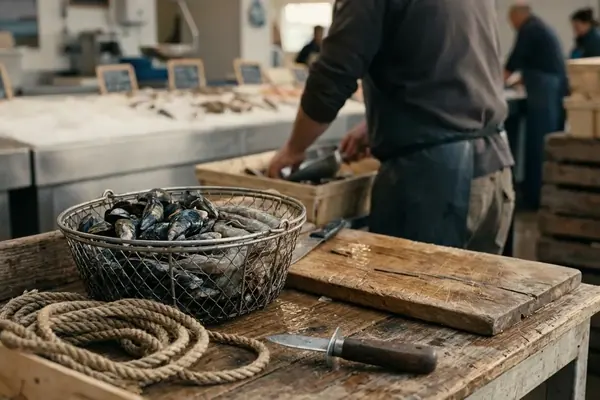
The geography behind Brussels’ mussel pots deserves the same precision as the order. Yerseke is a major Dutch shellfish trading and processing center in Zeeland, on the Oosterschelde. The Dutch Wadden Sea is a separate northern production area. Mussels passing through Zeeland need not have grown there.
Ask about the present supply, then distinguish where the shellfish grew from where it was handled. A supplier’s address and a growing area describe different stages of the same meal.
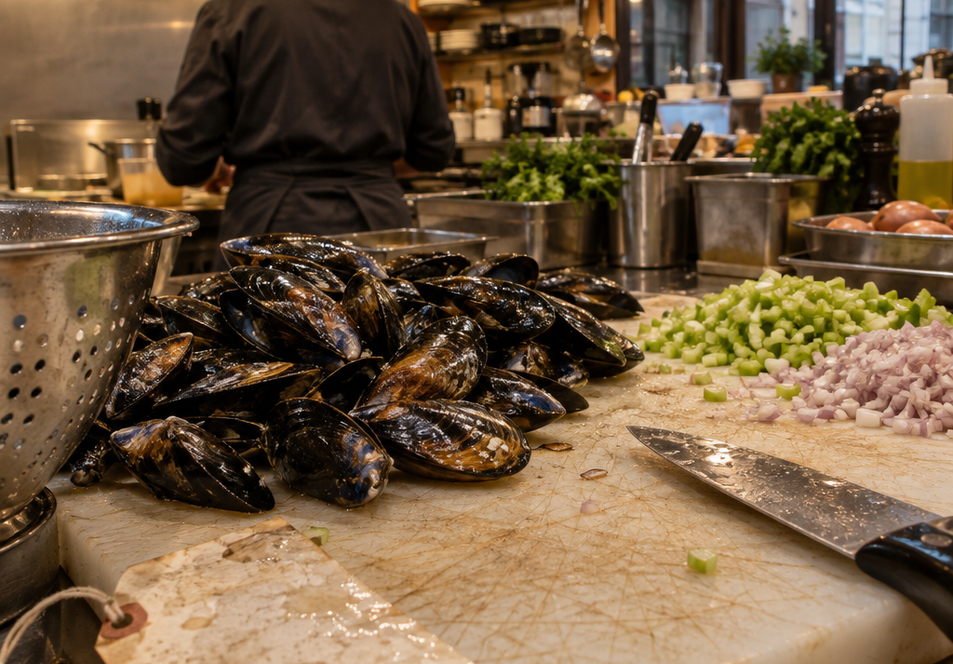
A mussel grown in the northern Dutch Wadden Sea can travel south to Zeeland for handling and dispatch before reaching a Brussels table: it crosses Dutch growing regions before it ever crosses the Belgian border.

Comments
Start the discussion.
Join the Discussion