
Read the Brussels Menu Before Ordering a Starter
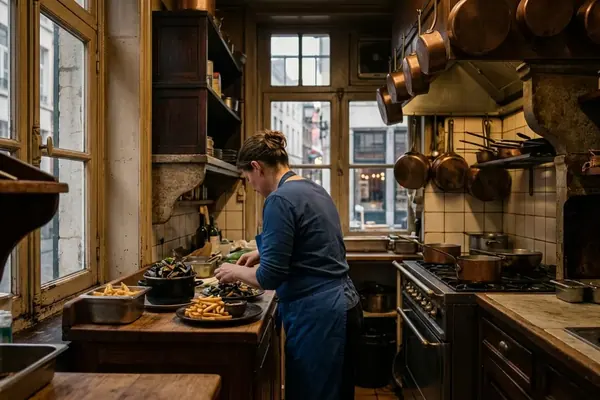
Step off the rain-dark cobblestones around Sainte-Catherine and into a wood-paneled brasserie. The room smells of butter, celery and steaming shellfish. An aproned waiter carries an ice-laden platter past your table; a heavy menu lands beside the bread.
I settle the appetite question first: a mussel casserole or a substantial seafood platter? Either can anchor the meal. A main-course pot is intended for one hungry diner, with shells accounting for much of its imposing volume. Add North Sea brown shrimp, crevettes grises, if you want a distinctly local starter: cold in a tomato or hot inside a crisp croquette.
For a quick orientation, read the menu headings this way:
- Banc d’Écailler: the shellfish counter and raw-bar selection.
- Entrées Froides / Entrées Chaudes: cold and hot starters.
- Moules: mussels, grouped by preparation.
- Poissons: fish dishes, usually main courses.
Then find the raw-bar pricing unit. À la pièce means each; les six or la demi-douzaine means six; prix au kilo means priced by weight. That small line determines what the quoted price buys. Settle it before choosing the platter.
Decode the Oysters and Shellfish on Ice
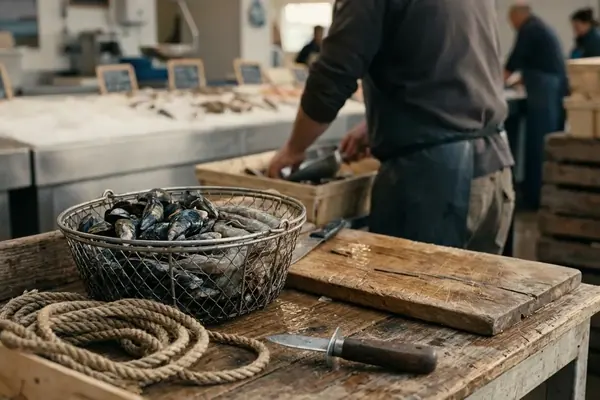
The écailler works at the entrance or shellfish counter, opening shellfish to order, checking their condition and arranging them over crushed ice. Watch the counter briefly and the menu becomes easier to picture.
Read Oyster Shape Before Size
Start with creuses, the deep-cupped oysters, or plates, European flat oysters. Next comes origin, then size. Ostend has a historic flat-oyster tradition, but a Belgian place name and an oyster’s species convey separate information.
For cupped oysters using the French numbering system, a No. 2 is larger than a No. 4: the size number runs in the opposite direction to the animal’s size. Flat oysters use their own grading conventions. Choose by the oyster’s description and your preferred mouthful rather than treating the lowest number as a quality ranking.
Find the Cooked Shellfish on the Platter
A plateau de fruits de mer can combine raw oysters with cooked, chilled shellfish. Bulots are whelks; bigorneaux are smaller periwinkles, extracted with a pin. Langoustines have slender bodies and claws; tourteau is brown crab.
Dark bread, butter and shallot vinegar belong beside the platter. Use the vinegar sparingly enough to taste the oyster underneath. It seasons raw shellfish; it does not make them microbiologically safe.
Calculate the Mussel Order Before the Pot Arrives
Read the stated shell-on portion weight before judging the casserole’s size. Live mussels, edible meat, fries and discarded shells are different quantities. The black pot accommodates bulky shells and cooking liquid; its volume can exaggerate how much flesh you are ordering.
A main-course casserole is normally an individual order. If you intend to share, say so when ordering rather than assuming the vessel signals a communal dish. Check whether fries accompany it before requesting another portion, especially after a substantial shrimp starter.
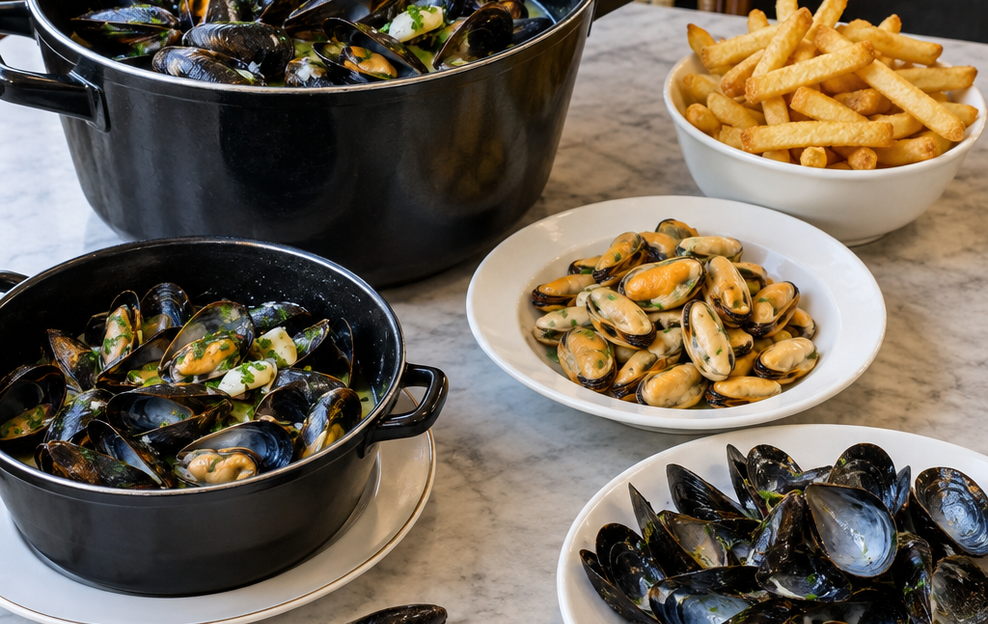
Choose the Broth, Then Check the Grade
- Marinière: onion or shallot, celery and often white wine.
- Au vin blanc: an explicitly wine-led broth, overlapping with marinière.
- À la crème: cooking juices enriched with cream.
- Provençale: tomato, garlic and herbs.
- Parquées: mussels opened raw on the half-shell, traditionally with a sharp mustard dressing.
Keep parquées separate from the steaming-pot decision: they carry the foodborne-illness risk of raw bivalves.
For size comparisons, use a stated count per kilogram because commercial labels such as Extra, Super, Impériale and Goldmerk are not a dependable cross-supplier scale. Fewer mussels per kilogram means larger individual shells. Meat yield depends separately on the mussels’ condition; a grand grade name cannot tell you how fully each shell is filled.
Follow the Mussel Season Into Shrimp, Sole and Eel
The old instruction to eat mussels in months containing an “R” misses part of the Dutch bottom-culture supply calendar. That selling season broadly runs from July into April, with May and June forming the usual transition between crops. For brasserie ordering, the useful question is what the kitchen is serving well today.
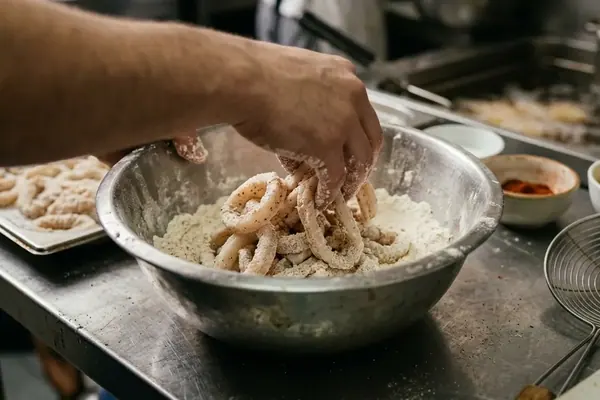
Two shrimp starters deserve close reading. Tomate-crevettes combines a peeled, hollowed tomato with peeled North Sea brown shrimp and mayonnaise. Look for explicit wording if hand-peeling or house-made mayonnaise matters to your choice. Croquettes aux crevettes grises wrap brown shrimp and a thickened filling in a fried breadcrumb crust, characteristically accompanied by fried parsley and lemon.
The coastal context extends beyond the plate: traditional coastal fishing and shrimp culture in Belgium includes horseback shrimp fishing at Oostduinkerke.
Among fish mains, sole meunière means sole cooked in butter and finished with lemon and parsley; tableside filleting is a service choice. Cabillaud is cod, while turbot keeps its familiar name. Anguilles au vert brings freshwater eel in a green herb sauce, often containing sorrel, into the broader repertoire of Belgian cuisine.
Use the Mussel Lid, Choose a Dry Drink, Ask for the Bill
Once the casserole arrives, eat the first mussel with a fork. Its empty hinged shell can then serve as pincers for lifting the remaining meat. Drop spent shells into the upturned deep lid or the discard bowl supplied. Continuing with a fork is perfectly acceptable; the shell technique simply makes efficient use of what is already on the table.
Choose drinks by intensity and acidity. A crisp Belgian pilsner, dry gueuze or Muscadet leaves room for delicate shrimp and oysters. With tripels, consider alcohol, sweetness and overall weight together: strength alone does not tell you whether the beer tastes sweet.
For the bill, ask for “L’addition, s’il vous plaît.” Waiting for that request is normal Brussels dining practice. Displayed restaurant prices include VAT and service, so a separate percentage-based tip is not expected. Rounding up or leaving a few euros rewards attentive care at your discretion.
And when the shrimp croquette arrives, consider the work inside its crust: the edible portion of a North Sea brown shrimp is the small tail, separated repeatedly from the head and shell.


Comments
Start the discussion.
Join the Discussion